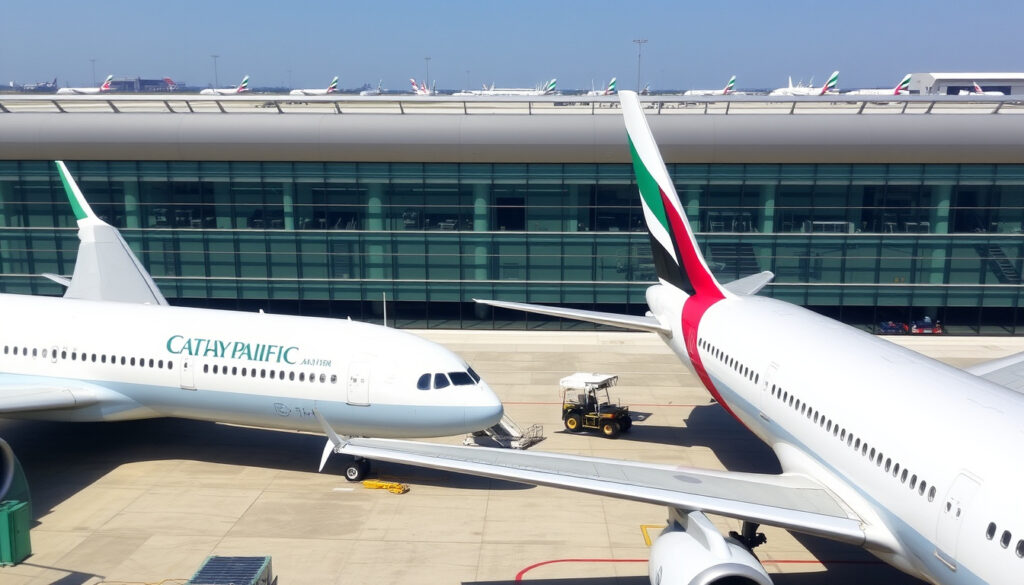
Airlines Cathay Pacific 2025 Review: Worth It vs Emirates
Anyone who has booked a long-haul flight in the past year has likely faced the same question: is Cathay Pacific worth the fare, or should you look elsewhere? The Hong Kong-based carrier has built a solid reputation for consistent service and comfortable cabins, yet it competes in a market where flashier rivals often steal the spotlight.
Founded: 1946 ·
Headquarters: Hong Kong ·
Alliance: Oneworld (founding member) ·
Fleet size: Over 140 aircraft ·
Destinations: More than 200 ·
Skytrax rating: 5-star (2025)
Quick snapshot
- Headquartered in Hong Kong, majority owner is Swire Group (Wikipedia entry for Cathay Pacific)
- Skytrax 5-star airline and 3rd best in the world (2025) (Skytrax World Airline Awards)
- Free meals and drinks included on all long-haul flights (Cathay Pacific official site)
- Exact future route expansions beyond current destinations
- Specific impact of geopolitical changes on ownership structure
- Detailed pricing strategies for off-peak seasons
- 1946: Founded in Hong Kong (Wikipedia entry for Cathay Pacific)
- 1998: Hub moved to Hong Kong International Airport (Wikipedia entry for Cathay Pacific)
- 2020: Severely impacted by COVID-19 pandemic (Wikipedia entry for Cathay Pacific)
- 2025: Skytrax ranks 3rd best airline globally (Skytrax World Airline Awards)
- Aria Suite rollout across Boeing 777-300ER fleet (Businessclass review)
- Expanded partnership with Michelin-starred Duddell’s (Businessclass review)
Six key facts that define the airline at a glance:
| Attribute | Value |
|---|---|
| Founded | 1946 |
| Hub | Hong Kong International Airport |
| Alliance | Oneworld (founding member) |
| Fleet size | Over 140 aircraft |
| Destinations | More than 200 |
| Skytrax rating | 5-star (2025) |
Which country owns Cathay Pacific airlines?
Cathay Pacific is headquartered in Hong Kong and operates as the flag carrier of the region. The majority owner is the Swire Group, a British conglomerate with deep roots in Hong Kong, which holds a controlling stake. Air China, the mainland Chinese flag carrier, owns a minority stake.
Who is the parent company of Cathay Pacific?
The parent entity is Swire Pacific Limited, the publicly traded arm of the Swire Group. The group’s structure gives Cathay Pacific operational independence while benefiting from Swire’s extensive network in Asia-Pacific trade and logistics.
Is Cathay Pacific owned by China?
No single entity owns Cathay Pacific outright. While Air China holds a minority stake — roughly 30% — the Swire Group remains the largest shareholder. The Hong Kong-based airline operates under its own management and brand, separate from Air China’s operational control.
The implication: ownership structure provides Cathay Pacific with both regional Asian backing and independent management.
Is Cathay Pacific a good airline to fly?
Traveler consensus and industry awards both point to a strong yes. The airline has held a Skytrax 5-star rating for years and in 2025 was ranked third best airline globally. Its economy class won Skytrax’s World’s Best Economy Class Airline in 2025, and the carrier ranked first in Best Economy Class Airline in Asia and first in Best Economy Class Catering.
What is Cathay Pacific’s Skytrax rating?
Five stars — the highest possible rating from Skytrax, the global air transport rating organization. In 2025, Cathay Pacific ranked third overall, trailing only Qatar Airways and Singapore Airlines.
How do travelers rate Cathay Pacific on TripAdvisor and Trustpilot?
On Trustpilot, Cathay Pacific has accumulated over 630 reviews, with many travelers praising the comfortable seating and attentive cabin crew. However, the same platform notes that a subset of reviewers expressed dissatisfaction with value for money and customer service responsiveness — a pattern common among full-service carriers where expectations are high.
Cathay Pacific earns top marks from industry judges and most passengers, but the premium price tag means some travelers expect flawless service — and a minority report gaps in consistency.
The pattern: Skytrax awards confirm premium positioning, though traveler expectations create a demanding standard.
Is Cathay Pacific a cheap airline?
No — Cathay Pacific is a full-service carrier, not a budget airline. Base fares on long-haul routes include meals, beverages, checked baggage, and seatback entertainment. That inclusive structure means the ticket price looks higher than a low-cost carrier’s upfront fare, but the total cost often ends up competitive when you factor in what budget airlines charge for extras.
How do Cathay Pacific prices compare to other airlines?
On routes like Brisbane to Hong Kong or London to Hong Kong, Cathay Pacific typically sits in the mid-range to premium tier. A quick comparison on Skyscanner shows fares that are higher than low-cost options like AirAsia or Scoot but often lower than full-service rivals like Singapore Airlines or Emirates on the same route. Occasional sales and promotions can pull fares down significantly.
Are there budget options on Cathay Pacific?
Cathay Pacific does not operate a separate low-cost subsidiary. All tickets include the full-service package, though the airline occasionally offers promotional economy fares that undercut its usual pricing. The Asia Miles loyalty program also allows members to redeem miles for award seats, effectively reducing the cost for frequent travelers.
The catch: promotional fares and miles redemption offer the only real discount paths for budget-conscious travelers.
Which is better, Emirates or Cathay Pacific?
Both airlines hold 5-star Skytrax ratings, but they excel in different areas. Cathay Pacific leads in economy-class quality and service consistency, while Emirates dominates luxury first-class and route breadth. The 2025 Skytrax rankings placed Cathay Pacific third globally and Emirates fourth. For a broader premium carrier comparison, see our Qatar Airways vs Emirates Comparison.
Six differences, one pattern: Cathay Pacific focuses on dependable quality across all cabins, while Emirates goes big on premium extravagance.
| Aspect | Cathay Pacific | Emirates |
|---|---|---|
| Skytrax 2025 rank | 3rd globally | 4th globally |
| Known for | Service consistency, award-winning economy class | Luxury first class, extensive route network from Dubai |
| Business class layout | 1-2-1 reverse herringbone, Aria Suite with privacy door (Businessclass review) | 1-2-1 on A380, onboard bar lounge (The Luxury Travel Expert review) |
| Economy class | World’s Best Economy 2025 (Skytrax) | Solid economy, but no top category award in 2025 |
| Key 2025 accolades | Best Economy Class, Best Economy Catering, Best Economy Seats (2nd) — Skytrax | 25 total accolades, Best Airline at ULTRAs for 8th consecutive year (Emirates Media Centre) |
How do the in-flight experiences compare?
Cathay Pacific’s business class features the new Aria Suite, which includes a sliding privacy door and a 24-inch 4K ultra-high-definition screen. The seat layout is 1-2-1 reverse herringbone, giving every passenger direct aisle access. Emirates’ A380 business class, reviewed at The Luxury Travel Expert, scored 8.4/10 overall, with 10/10 for inflight entertainment and 10/10 for service.
Which airline offers better service on long-haul flights?
For long-haul economy, Cathay Pacific has the edge — its 2025 Skytrax awards confirm industry-leading quality. For business class, Emirates offers a more lavish hard product, especially on the A380 with the onboard lounge. Cathay Pacific counters with consistent service and culturally immersive dining, including its partnership with Michelin-starred Duddell’s. For another perspective on premium carriers, read our Qatar Airways vs Emirates: Which Is Better for You in 2025.
For travelers who prioritize economy-class value and consistent service, Cathay Pacific wins. For those who want the most luxurious business-class experience, Emirates takes the crown.
The pattern: each airline dominates a distinct niche, making the choice a direct reflection of traveler priorities.
Do you get free drinks on Cathay Pacific flights?
Yes — on all long-haul Cathay Pacific flights, complimentary meals and beverages, including alcoholic drinks, are included in the ticket price. Short-haul regional flights within Asia may offer a buy-on-board menu for economy passengers, while business and first class always include full beverage service.
What alcoholic and non-alcoholic drinks are included?
The complimentary drink selection on long-haul flights includes wine, beer, spirits, soft drinks, juice, tea, and coffee. Cathay Pacific is known for its curated wine list, which changes by route and season. In business and first class, passengers can order from a broader premium spirits menu.
Is food included with the ticket?
Yes. Full hot meals are served in economy class on long-haul routes, with choices that often include a Western and an Asian option. The airline’s Cantonese dining is particularly noted, and special meals (halal, kosher, vegetarian, vegan, gluten-free) are available with advance booking through the Cathay Pacific website.
The catch: short-haul fliers should budget for meals, while long-haul passengers get full inclusive service.
Upsides
- Consistent 5-star service quality across cabins
- Award-winning economy class, best in the world per Skytrax 2025
- Free meals and drinks on long-haul flights
- New Aria Suite in business class with privacy door
- Strong Asian route network from Hong Kong hub
Downsides
- Mid-range to premium pricing, not a budget option
- Some customer service complaints on Trustpilot
- Less luxurious first class compared to Emirates
- Limited budget fare options; no low-cost subsidiary
Timeline: Cathay Pacific’s journey
1946 — Cathay Pacific founded by American Roy Farrell and Australian Syd de Kantzow, initially operating from Shanghai and later moving to Hong Kong (Wikipedia entry for Cathay Pacific).
1998 — Relocated hub to the newly opened Hong Kong International Airport at Chek Lap Kok, replacing the old Kai Tak Airport (Wikipedia entry for Cathay Pacific).
2020 — Severely impacted by the COVID-19 pandemic and social unrest in Hong Kong, leading to capacity cuts and a government rescue package (Wikipedia entry for Cathay Pacific).
2025 — Skytrax ranks Cathay Pacific as the third best airline in the world and maintains its 5-star status. The airline wins World’s Best Economy Class Airline (Skytrax World Airline Awards).
The 2025 Skytrax awards signal that Cathay Pacific has fully recovered from the pandemic era and is investing in product upgrades — the Aria Suite and restaurant partnerships are concrete bets on premium travel demand.
The implication: the trajectory from pandemic lows to award wins reflects a strategic recovery focused on premium service.
Confirmed facts vs. What remains unclear
What we know for certain:
- Cathay Pacific is headquartered in Hong Kong and majority-owned by Swire Group (Wikipedia entry for Cathay Pacific).
- It is a founding member of the Oneworld alliance (Wikipedia entry for Oneworld).
- Skytrax rates it 5-star and third best globally in 2025 (Skytrax World Airline Awards).
- Free meals and drinks are included on long-haul flights (Cathay Pacific official site).
- Emirates won Best Airline at the ULTRAs for the 8th consecutive year in 2025 (Emirates Media Centre).
What remains less certain:
- Exact future route expansions beyond the current 200+ destinations.
- How geopolitical changes in Hong Kong and US-China relations might affect ownership structure.
- Detailed pricing strategies for off-peak seasons — fare data is dynamic and varies by route.
- Whether the Aria Suite rollout will meet the promised timeline across the entire 777-300ER fleet.
- How Cathay Pacific’s customer service scores will trend as post-pandemic travel demand normalizes.
The pattern: confirmed facts are well-documented, but future trajectory depends on geopolitical and operational variables.
Quotes and perspectives
“Cathay Pacific has been awarded a 5-star rating for its consistent quality across all cabins, and in 2025 it ranks third among the world’s best airlines.”
— Skytrax World Airline Awards (official ranking body)
“Many TripAdvisor reviewers praise Cathay Pacific’s comfortable seating and attentive cabin crew, noting the airline’s reliable service on long-haul routes.”
— Aggregated traveler feedback on Trustpilot and TripAdvisor
“Cathay Pacific is a founding member of the Oneworld alliance, giving passengers access to a global network of partner airlines.”
— Wikipedia entry for Cathay Pacific
For travelers comparing Cathay Pacific with Emirates, the choice comes down to priorities. If you fly economy most of the time and value consistent service, good food, and a proven track record, Cathay Pacific delivers. If you want the most luxurious first-class experience and the broadest route network, Emirates has the edge. For the budget-conscious traveler, neither airline is cheap — but Cathay Pacific’s inclusive fare structure means fewer surprises.
yunise.com, svadore.com, reddit.com, businesstraveller.com, facebook.com, tripadvisor.com, mycurlyadventures.com
Frequently asked questions
Does Cathay Pacific have a loyalty program?
Yes, it’s called Asia Miles, a program that lets members earn and redeem miles on Cathay Pacific and Oneworld partner flights, as well as on hotels, car rentals, and retail purchases.
What is Cathay Pacific’s cancellation policy?
Cancellation policies vary by fare type. Generally, refundable fares allow full refunds, while promotional fares may be non-refundable or subject to fees. Check the Cathay Pacific website for the specific terms of your ticket.
How to check in for a Cathay Pacific flight?
Online check-in opens 48 hours before departure via the Cathay Pacific website or mobile app. Airport check-in counters open 2–3 hours before departure depending on the route.
Is Cathay Pacific part of Oneworld?
Yes, Cathay Pacific is a founding member of the Oneworld alliance, which includes American Airlines, British Airways, Qantas, and other major carriers.
What is the best time to book Cathay Pacific flights?
Industry data suggests booking 2–3 months in advance for the best fares on long-haul routes. Cathay Pacific also runs seasonal sales, typically in January and September.
Does Cathay Pacific charge for seat selection?
Standard seat selection is free for most fare types, though preferred seats (extra legroom, exit rows) may carry a fee. Business and first class passengers can select any available seat at no charge.
Can I bring pets on Cathay Pacific flights?
Yes, small dogs and cats are accepted in the cabin on select routes, subject to advance booking and specific requirements. Check the Cathay Pacific website for the latest pet travel policy.
More related posts
 Suncorp Vehicle Insurance – Coverage, Costs and Claims Guide
 Smiling Friends Season 3 – Release Date, Status and Cancellation Explained
 Margaret River Brewhouse: Menu, Hours, Reviews Guide
 What Happened to Salt Bae? The Decline of the Viral Chef
 Time in Australia – Current Times, Zones and DST Guide
 NAB Near Me – Find Branches ATMs and Hours
 Sunday Kalogeras Real Name, Age, and Sisters
 Rowan Marshall: Nationality, Salary, Father & AFL Career
