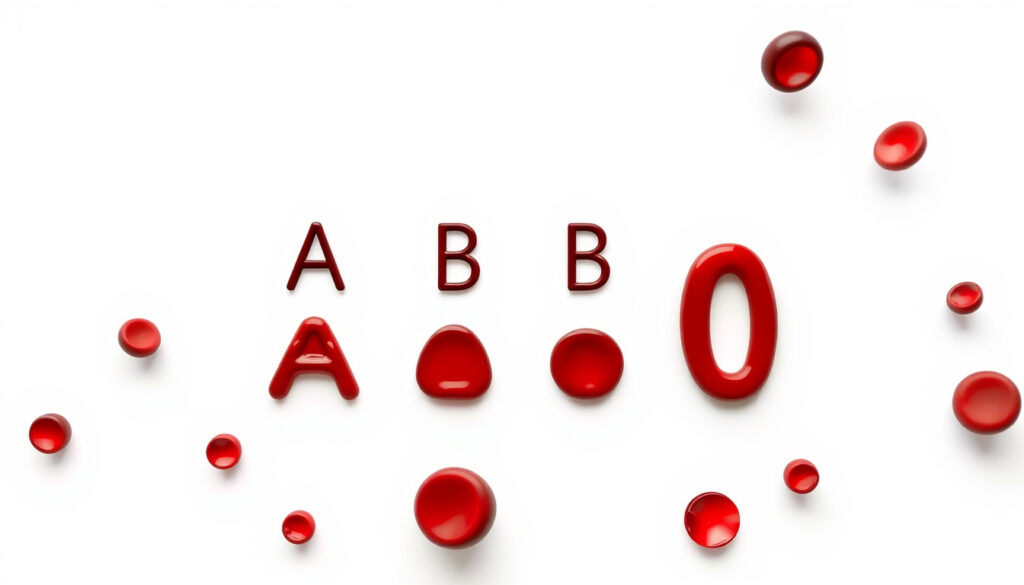
Blood Types: Rarest and Most Common in Ireland
Blood types are determined by the ABO and Rh systems, producing eight distinct groups. In Ireland, the distribution is striking: nearly half the population shares O positive, while AB negative is held by only 1 in a hundred donors, creating a constant challenge for blood banks.
Blood groups (ABO + Rh): 8 ·
Most common in Ireland: O positive (47%) ·
Rarest in Ireland: AB negative (1%) ·
Universal donor: O negative ·
Universal recipient: AB positive
Quick snapshot
- AB negative is the rarest blood type in Ireland at 1% of donors (Irish Blood Transfusion Service).
- O positive is the most common blood type in Ireland at 47% (Irish Blood Transfusion Service).
- O negative is the universal donor for red blood cells (American Red Cross).
- Which blood type is “healthiest” remains debated — evidence is not conclusive.
- Correlation between blood type and ADHD has only preliminary evidence.
- Blood type distribution is genetically stable; no major shifts expected in the near future.
- Ongoing research into blood type links to disease risk, and continued need for diverse donor pools.
Here is how the eight blood types break down across the Irish donor population.
| Blood group | Frequency in Ireland | Notes |
|---|---|---|
| O positive | 47% | Most common (Irish Blood Transfusion Service) |
| A positive | 26% | Second most common (Irish Blood Transfusion Service) |
| B positive | 9% | Irish Blood Transfusion Service |
| O negative | 8% | Universal donor (NHS Blood Donation) |
| A negative | 5% | Irish Blood Transfusion Service |
| B negative | 2% | Irish Blood Transfusion Service |
| AB positive | 2% | Universal recipient (American Red Cross) |
| AB negative | 1% | Rarest (Irish Blood Transfusion Service) |
Which is the rarest blood type?
AB negative is the rarest blood type in the ABO/Rh system. In Ireland, less than 1% of donors have AB negative blood, according to the Irish Blood Transfusion Service (IBTS). A 2021 peer-reviewed study refined the frequency to 0.58% for AB negative in the modern Irish population (PMC, peer-reviewed study on Irish blood groups).
What is the top 3 rarest blood type?
- AB negative (rarest) — 1% in Ireland (IBTS)
- B negative — 2% in Ireland (IBTS)
- AB positive — 2% in Ireland (IBTS)
Globally, AB negative is also the rarest, typically found in about 1% of the population (American Red Cross).
For Irish blood banks, maintaining a supply of AB negative is a constant challenge because so few donors carry it. Hospitals rely on targeted recruitment and rare donor registries to meet emergency needs.
Is O+ a rare blood group?
O positive is not rare — it is the most common blood group in Ireland at 47% of the population (Irish Blood Transfusion Service). Globally, O positive is also the most frequent, making up about 37-40% of people worldwide (American Red Cross).
What is the 3 most common blood types?
- O positive (47% in Ireland) — most common
- A positive (26%) — second most common (IBTS)
- B positive (9%) — third most common (IBTS)
O positive is the most frequent globally as well, followed by A positive and B positive (American Red Cross).
The implication: O positive donors are the backbone of the blood supply, but their blood cannot be given to everyone, which is why O negative remains so critical.
What blood type do most Irish have?
O positive is the most common blood type in Ireland, at 47% of the population (Irish Blood Transfusion Service). The same data appears in a 2026 country ranking table compiled by World Population Review (blood type distribution 2026), which reports O positive at 47%, A positive at 26%, B positive at 9%, and AB positive at 2%.
Why is Irish DNA so unique?
Ireland has a high concentration of O blood type, especially in the west of Ireland, where the Irish Blood Transfusion Service notes that people are predominantly group O. This pattern is linked to genetic isolation — the island’s historical separation from mainland Europe preserved a higher frequency of the O allele. The same IBTS page points out that areas with Viking, Anglo-Norman, and English settlements have a higher concentration of group A blood, reflecting migration patterns. Rhesus negative blood is also more common on the east coast than the west (IBTS).
Ireland’s O-rich blood profile is a legacy of isolation, but it also means that when Irish patients need transfusions, the local donor pool is skewed toward O types — making it harder to match A, B, and AB recipients in mixed-heritage communities.
Why can’t O+ donate to everyone?
O positive blood cannot be transfused to Rh-negative recipients because the Rh antigen on O positive red cells triggers an immune response in Rh-negative patients. The NHS Blood Donation explains that Rh-negative individuals can only receive Rh-negative blood. O negative blood, which lacks A, B, and Rh antigens, is the universal donor (American Red Cross).
Universal donor O negative
O negative is the only blood type that can be given to any patient in an emergency when the recipient’s blood type is unknown. The American Red Cross calls it “the universal donor.” Only about 8% of the Irish population has O negative, so it is always in high demand.
Rh factor compatibility
Rh factor compatibility is critical: an Rh-positive person can receive Rh-positive or Rh-negative blood, but an Rh-negative person must receive only Rh-negative blood. That is why O positive — despite being the most common — cannot serve as a universal donor (NHS Blood Donation).
The trade-off: O positive is the workhorse of blood banks, but its Rh-positive status limits its use to Rh-positive recipients only.
Is there a healthiest blood type?
Some studies suggest that blood type O may carry a lower risk of certain blood clots, but no blood type is universally “healthiest.” The 2021 peer-reviewed study on Irish blood groups did not examine health outcomes. The American Red Cross notes that any link between blood type and disease risk is still being researched and is not conclusive.
Blood type and disease risk
According to a review by the American Red Cross, some research has associated type O with a lower risk of heart attack and stroke, while types A, B, and AB may have slightly higher risks of certain cancers. However, these associations are not strong enough to guide individual health decisions.
Correlation between ABO blood type gene and attention-deficit
Preliminary research has suggested a possible link between the ABO gene and attention-deficit hyperactivity disorder (ADHD), but the evidence is limited and not replicated. A 2021 study in China reported a correlation, but the Irish blood group study did not address this. More research is needed before any conclusions can be drawn.
The catch: without robust, independent replication, the ADHD–blood type link remains speculative. Irish readers should not base any health decisions on this connection.
Eight blood types, one pattern: the distribution in Ireland differs from the global average, most notably in the high proportion of O positive and the low frequency of AB groups.
| Blood type | Ireland (%) | Global average (%) | Source |
|---|---|---|---|
| O positive | 47 | 37-40 | IBTS / Red Cross |
| A positive | 26 | 30-33 | IBTS |
| B positive | 9 | 8-10 | IBTS |
| O negative | 8 | 5-8 | IBTS |
| A negative | 5 | 5-7 | IBTS |
| B negative | 2 | 1-2 | IBTS |
| AB positive | 2 | 3-4 | IBTS |
| AB negative | 1 | 1 | IBTS |
What this means: Ireland’s O-positive share is noticeably higher than the global average, while A-positive is slightly lower. This is consistent with the genetic isolation hypothesis and has practical implications for blood inventory planning.
Confirmed facts
- AB negative is the rarest blood type in Ireland (1% of donors) — IBTS
- O positive is the most common blood type in Ireland (47%) — IBTS
- O negative is the universal donor — American Red Cross
What’s unclear
- Which blood type is “healthiest” remains debated — evidence not conclusive.
- Correlation between blood type and ADHD has only preliminary evidence.
“O positive is the most common blood group in Ireland at 47% of the population. AB negative is the least common at 1%.”
— Irish Blood Transfusion Service (national blood authority)
“O negative is the universal donor, meaning it can be given to anyone in an emergency.”
— NHS Blood Donation (UK health service)
“The Rh factor is inherited; if you are Rh-positive, you can receive Rh-positive or Rh-negative blood, but if you are Rh-negative, you can only receive Rh-negative blood.”
— American Red Cross (humanitarian organisation)
For Irish blood services, the distribution is clear: O positive dominates the donor pool, but the rarest groups — especially AB negative — require constant targeted recruitment. The genetic uniqueness of Ireland’s blood profile, shaped by centuries of isolation, means that the mix of donors does not perfectly mirror the global average. The implication for anyone living in Ireland: if you know your blood type, consider donating — especially if you are AB negative, B negative, or O negative, because your blood is in short supply when patients need it most.
Related reading: Blood group basics · Blood Type: Rarity, Inheritance, Compatibility & Irish Data
en.wikipedia.org, poplix.uk, mediaroar.uk, youtube.com, civicviewpoint.net, usq.pressbooks.pub, semanticscholar.org
Frequently asked questions
What are the 8 blood types?
The eight blood types are A+, A-, B+, B-, AB+, AB-, O+, and O-. They are determined by the ABO system (A, B, AB, O) and the Rh factor (positive or negative).
How is blood type determined?
Blood type is inherited from your parents. The ABO gene determines which antigens appear on your red blood cells, and the RhD gene determines the Rh factor. American Red Cross
Can blood type change?
Blood type is usually fixed for life. Very rarely, a bone marrow transplant can change the recipient’s blood type to match the donor’s. NHS Blood Donation
Why is blood type important for donation?
Matching blood type prevents immune reactions. If you receive incompatible blood, your body may attack the donor cells, causing serious complications. American Red Cross
Is O negative rare?
O negative is not the rarest but is still relatively uncommon — about 8% of the Irish population has it. It is the universal donor, so it is always in high demand. Irish Blood Transfusion Service
What blood type do most people in the US have?
The most common blood type in the US is O positive, at about 38% of the population. American Red Cross
Does blood type affect personality?
There is no scientific evidence that blood type determines personality. The idea is popular in Japan (ketsuekigata) but is not supported by research. PMC study on blood groups
More related posts
 DALL-E Shutdown Guide: Facts, Timeline & Alternatives
 What Is 67 Meme – Origin, Meaning, TikTok Trend Explained
 Telstra Mobile Plans: Prices, Value & Comparisons
 Miranda Otto Biography: Age at Éowyn Role, Family & Career
 Finnbar Maley: AFL Career, Height & Family
 Jordan Matter: Net Worth, Family, Career & Daughter Salish
 Payton Pritchard: Wife, Salary, Net Worth, and Career Highlights
 Jo Yuri: Biography, Relationship Status & Career 2025
