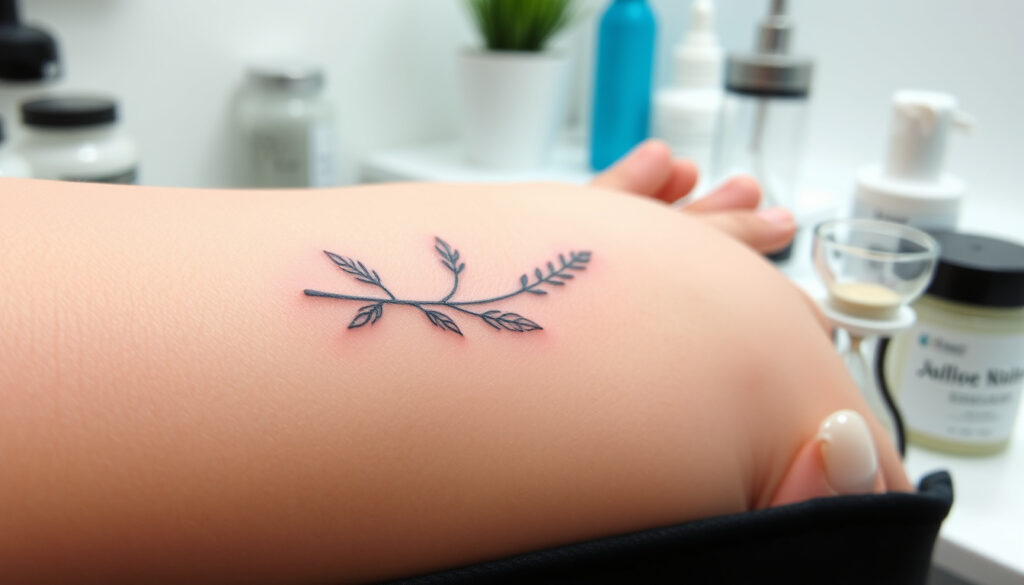
Fine Line Tattoo: Pros, Cons & Longevity Guide
There’s something quietly compelling about a tattoo drawn so lightly it barely whispers against the skin, and fine line tattooing has grown into one of the most requested styles in Dublin studios for good reason. This guide breaks down what you can realistically expect, from healing times to long-term trade-offs.
Surface healing: within two weeks · Touch-ups (exposed spots): every 3–5 years · Cost range (small design): €80–€150
Quick snapshot
- Fine line designs use minimal ink and a delicate approach (XOXO Tattoo Dublin, a leading fine line studio)
- Surface healing for small-to-medium fine line tattoos completes within two weeks (IGLA Tattoo, an industry editorial source)
- Touch-ups on hands or neck are typically needed every 3–5 years (Removery, a tattoo removal and care resource)
- How much artist technique and skin type affect long-term blurring remains underdocumented
- Pain comparisons with traditional tattooing lack large-scale studies
- The exact origin of the “1/3 rule” in tattooing is not recorded in textbooks
- Surface heal within 2 weeks (IGLA Tattoo)
- Avoid soaking for at least the first 2–3 weeks, ideally the first month (XOXO Tattoo aftercare guide; Claire Everywhere, a Dublin-based studio)
- Second-skin bandage can stay 24 hours up to 5 days, must be removed by day 10 (Claire Everywhere)
- First touch-up on exposed skin often needed within 3–5 years (Removery)
- Once healed, apply SPF 50+ sunscreen to exposed placements (XOXO Tattoo Dublin)
- Choose a studio with fine line specialism and review artist portfolios (XOXO Tattoo Dublin)
- Budget for touch-ups every few years, especially on hands, neck, or sun-exposed spots (XOXO Tattoo Dublin)
What Does Fine Line Mean in Tattooing?
Defining the technique
- Fine line tattooing uses a single needle or a very small grouping — typically a 3–5 round liner (XOXO Tattoo Dublin)
- Line width is kept extremely thin, creating a delicate, sketch-like appearance
- Artists rely on precise hand speed and depth control to maintain clean, consistent lines
The result is a look that feels more like a pencil drawing than a traditional bold-ink tattoo. Most Dublin studios emphasise that the technique is fundamentally about restraint — less ink, thinner lines, and a softer overall impact.
Needle gauge and line width comparison
- Standard tattooing often uses a 7–9 round liner, producing lines 1–2 mm wide
- Fine line work, by contrast, uses 3–5 RL needles that create lines roughly 0.25–0.5 mm wide
- Healing differences: fine line tattoos heal on the surface within about two weeks, while heavily saturated work can take three to four weeks (IGLA Tattoo)
The trade-off: thinner lines mean less trauma to the skin, but also less ink to absorb the natural spread that happens as skin ages.
Do Fine Line Tattoos Last Long?
Factors affecting longevity
- Placement is the biggest determinant — fine line tattoos on hands, fingers, or neck may need a touch-up every 3–5 years (Removery)
- In discreet, sun-shielded locations, a fine line tattoo can last about ten years before requiring a refresh (Removery)
- Sun exposure accelerates fading — once healed, SPF 50+ sunscreen is strongly recommended (XOXO Tattoo Dublin aftercare guidance)
- Aftercare during the first few weeks is critical: keep the tattoo clean, moisturised, out of the sun, and away from soaking (XOXO Tattoo Dublin)
Ireland’s wet, high-UV seasonality means a fine line tattoo on exposed skin faces fading pressure from both sun and constant moisture. A client in Dublin or Cork must be more disciplined with aftercare than someone in a consistently dry climate.
Touch-up frequency expectations
- Small-to-medium fine line designs usually need a touch-up every 2–5 years, depending on placement and aftercare
- Hands and neck: expect touch-ups as often as every 3 years (Removery)
- Discreet spots (upper arm, back, thigh): can go up to a decade between refreshes (Removery)
The implication: a fine line tattoo is not a one-and-done investment. Anyone considering it should factor in the long-term cost of touch-ups.
What Are the Downsides of Fine Line Tattoos?
Common issues: blurring, fading, and design limitations
- Blurring occurs as ink naturally spreads in the skin over time — thinner lines are more susceptible to losing their crisp definition
- Very thin lines may become barely visible or disappear entirely, especially on high-movement areas
- Design complexity is limited by line width — fine details like dense lettering or tiny faces can “close up” as the ink spreads
- Colour retention is often poorer than traditional blackwork; many fine line tattoos rely on black or grey wash for the delicate look
The catch: the same subtlety that makes fine line appealing also makes it fragile. Choosing a design with enough negative space and a skilled artist who understands ink spread over time is essential.
Is a Fine Line Tattoo Painful?
Pain comparison to traditional tattooing
- Because fine line uses a smaller needle grouping (3–5 RL vs 7–9 RL), the pain is generally reported as lower or similar – less surface trauma per pass
- However, the pain difference is marginal; sensitive areas such as ribs, wrists, and ankles still cause significant discomfort
- Bone proximity (like on the hand or collarbone) increases the perceived sting regardless of needle size
Bottom line: fine line is not a pain-free shortcut. It feels different — more of a scratch than a stab — but placement matters far more than technique when it comes to discomfort.
What Is the 1/3 Rule in Tattooing?
Purpose of the 1/3 rule
- The 1/3 rule is a composition principle borrowed from photography and visual art, not a strict tattooing guideline
- It suggests dividing the body area into thirds and placing the tattoo at one of the intersection points for balanced visual appeal
- In fine line work, the rule is often used to guide placement of delicate motifs (e.g., a stem along the forearm’s natural curve)
Why this matters: understanding the rule helps you communicate placement preferences to your artist. It’s a design best practice, not a technical constraint.
Are Fine Line Tattoos Worth It in 2026? – Pros and Cons
Pros of fine line tattoos
- Delicate, minimalist aesthetic that many find more elegant and less overwhelming than traditional tattoos
- Less scarring and lighter skin trauma due to smaller needle grouping
- Quicker surface healing (around two weeks for small-to-medium designs) (IGLA Tattoo)
- Generally reported as less painful than equivalent-sized traditional tattoos
Cons and trade-offs
- Shorter lifespan on exposed skin — touch-ups needed every 3–5 years (Removery)
- High risk of blurring if artist technique is poor or if placed on high-movement areas
- Not ideal for heavily sun-exposed skin or locations with constant rubbing (hands, feet)
- Design options are constrained — intricate details may close up over time
Who should consider fine line?
- Ideal for first tattoos, minimalist designs, and clients who want something subtle
- Best suited for discreet, low-movement placements (inner arm, shoulder, thigh)
- Less recommended for people who work outdoors or spend significant time in the sun without strict UV protection
Upsides
- Delicate aesthetic, less scarring, quicker surface healing, lower reported pain
Downsides
- Shorter lifespan, regular touch-ups, blurring risk, design limitations, poor for sun-exposed areas
The pattern: fine line tattooing excels for low-commitment, subtle body art, but demands ongoing maintenance and careful placement. For someone in Ireland choosing between a fine line piece and a traditional tattoo, the real question is not “which is better” but “which fits your skin’s reality and your willingness to revisit the studio.”
Where to Get a Fine Line Tattoo in Ireland? – Studio Guide
Dublin walk-in fine line studios
- XOXO Tattoo specialises in fine line with emphasis on aging and aftercare
- Claire Everywhere offers fine line with a focus on healing and long-term results
- The Ink Factory (Dublin 2) is known for single‑needle and fine line work
Artists in Limerick, Galway, Cork, Waterford
- Independent artists are active on Instagram (e.g., @mendjeli_tattoo, @stephen_doyle_tattoo)
- Availability varies; most require booking in advance
- Choose a studio with fine line specialism and review portfolios of healed work
For perspective on quality investments, see our Gold Necklace: 14k vs 18k vs 24k Guide.
Aftercare Essentials for Fine Line Tattoos in Ireland
Immediate aftercare (first 2–4 weeks)
- Wash hands before touching the tattoo, clean with lukewarm water and mild fragrance-free soap, and pat dry with a clean paper towel (XOXO Tattoo aftercare guide; Healthline, a trusted medical resource)
- A thin layer of aftercare cream is preferable — too much can suffocate the skin and slow healing (XOXO Tattoo aftercare guide)
- Avoid soaking in baths, pools, hot tubs, lakes, or the sea for at least 2–3 weeks (XOXO Tattoo); some guidance extends this to a full month (Claire Everywhere)
- If a second-skin bandage is used, keep it on for 24 hours up to 5 days unless irritation develops; remove by 10 days at most (Claire Everywhere)
Long-term maintenance
- Once fully healed, apply SPF 50+ sunscreen every time the tattoo is exposed to sunlight (XOXO Tattoo Dublin)
- Moisturise regularly to keep the skin supple and slow ink spread
- Monitor for fading; plan for a touch-up every 3–5 years on exposed spots, longer on covered spots
Ireland’s rainy climate and unpredictable UV spikes mean aftercare isn’t just a first-month chore — it’s a long-term habit. Sunscreen becomes part of everyday wardrobe.
Quotes on Fine Line Tattoos
“Proper aftercare during the first few weeks is critical for fine line tattoos. They’re more delicate than traditional work, so any slip in the healing routine can affect the final line quality.”
— XOXO Tattoo Dublin aftercare guidance
“Avoid soaking in lakes, oceans, bathtubs, and pools for the first month, especially during the first two weeks. The skin needs that time to fully re-knit.”
— Claire Everywhere, Dublin-based studio aftercare page
“Keep a new tattoo out of the sun until it is fully healed. Then use sunscreen every time – the sun is the biggest enemy of a fine line’s longevity.”
— Healthline general tattoo aftercare advice
A fine line tattoo gives you elegance today, but demands vigilance tomorrow. For a client in Dublin, the decision comes down to this: commit to aftercare for the life of the tattoo, or accept that the fine lines may become a ghost of the design within a few years.
The choice is clear: fine line is for those ready to maintain it.
theblackhattattoo.com, rogueraven.ink, killerinktattoo.ie, burnedhearts.com, smileydogg.com, reddit.com
Frequently asked questions
How much does a fine line tattoo cost in Ireland?
Small fine line designs (palm-sized) typically cost €80–€150. Top Dublin artists may charge €150–€300 per piece. Touch-up rates vary, often a reduced session fee.
Can fine line tattoos be touched up easily?
Yes. Most artists will touch up a fine line tattoo as long as the design is still visible. The cost is usually lower than the original piece. Touch-ups are recommended every 3–5 years on exposed spots, longer on covered spots (Removery).
What designs work best for fine line tattooing?
Floral stems, geometric outlines, single-line portraits, and minimalist symbols are popular. Avoid dense clusters of tiny details — they tend to blend together over time.
Is fine line tattooing suitable for dark skin tones?
Yes, but the contrast is lower. Fine line designs on darker skin may appear softer. Work with an artist experienced in fine line on melanin-rich skin for best results.
How do I choose a good fine line tattoo artist?
Look for portfolios showing healed work (not just fresh). Ask about their touch-up policy. In Ireland, check Instagram tags like #finelinedublin or studio pages of XOXO Tattoo and Claire Everywhere.
Do fine line tattoos hurt more than microblading?
Microblading uses a manual blade and is often described as more intense because of the cutting motion. Fine line tattooing is a machine-driven scratching sensation. Most people find fine line less uncomfortable.
Where can I get a fine line tattoo in Dublin?
XOXO Tattoo is a Dublin studio specialising in fine line. Claire Everywhere offers fine line with a focus on aging. Many independent artists are active on Instagram; booking is generally required.
More related posts
 Jordan Matter: Net Worth, Family, Career & Daughter Salish
 Arijit Singh: Biography, Net Worth, Retirement & Personal Life
 Ezra Miller: Legal Timeline, Identity, and Career Updates (2026)
 Cyclone Alfred Tracker Live – BOM Maps, Path and Impacts
 Dylan Alcott: Disability Cause, Partner, Baby, Net Worth
 Luther Vandross: Cause of Death, Net Worth, and Legacy
 David Hasselhoff Wheelchair Photos – Airport Sightings Explained
 Becca Bloom: Bio, Wealth, Husband, and Family Background
