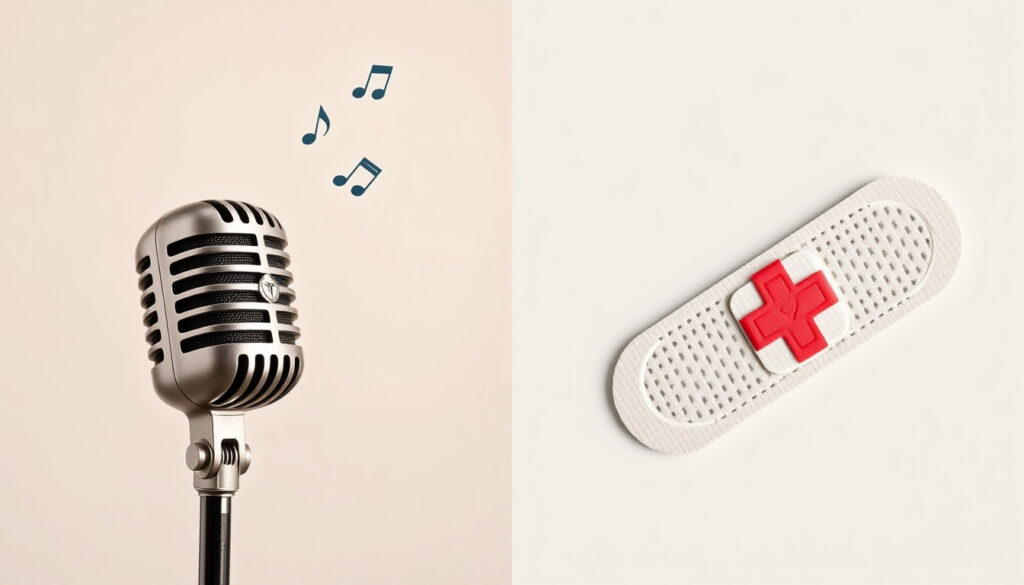
Band Aid: Charity Supergroup vs. Bandage Brand History
Most people hear “Band Aid” and conjure a single image — but it’s actually two completely different stories living under the same name. One is a charity supergroup that raised millions for famine relief in the 1980s. The other is a household adhesive bandage brand that’s been patching up scrapes for over a century.
Original Band Aid song release: 1984 ·
Band Aid Charitable Trust funds raised: £145 million ·
Number of artists in original recording: 36 ·
Band-Aid brand introduced: 1920
Quick snapshot
- The song “Do They Know It’s Christmas?” was written in 1984 by Bob Geldof and Midge Ure (Wikipedia (encyclopedic reference)).
- Band-Aid brand adhesive bandages were invented in 1920 by Earle Dickson (BAND-AID® Brand (official brand history)).
- Exact reason Bob Geldof reportedly called Queen “peacocks” before Live Aid — disputed, no official confirmation.
- Ed Sheeran’s refusal to allow reuse of his 2014 vocal – the Band Aid Trust apologized, but Sheeran’s own statement is not publicly verified.
- Number of artists in original Band Aid recording sometimes reported as 36, but other sources list different counts.
- Exact amount raised by Band Aid Charitable Trust is reported as £145 million, but variations exist.
- 1920: Band-Aid invented · 1984: Supergroup records · 2014: Band Aid 30 re-release · 2024: Ed Sheeran refuses vocal reuse.
- Future charity versions likely, but the brand vs. supergroup naming confusion will persist without a clear separation in media.
One name, two completely different entities: a charity supergroup that raised over £145 million and a medical supply brand that sells millions of bandages every year. The catch is that neither wants to give up the name.
The table below summarizes the key facts about both Band Aid entities.
| Attribute | Details | Source |
|---|---|---|
| Song release date | December 3, 1984 | Wikipedia (encyclopedic reference) |
| Number of artists | 36 | Remind Magazine (pop culture publication) |
| Funds raised | £145 million | Wikipedia (encyclopedic reference) |
| Brand origin | 1920 by Earle Dickson | BAND-AID® Brand (official brand history) |
| UK term for bandage | “plaster” | BAND-AID® Canada (regional brand site) |
Who was in Band Aid in 1984?
The 1984 supergroup brought together 36 of the biggest names in British and Irish pop music. The recording session at Sarm West Studios in London on November 25, 1984, included Bob Geldof, Midge Ure, George Michael, Boy George, Paul McCartney, and many more (Wikipedia (encyclopedic reference)).
What was the full lineup of Band Aid 1984?
- Bob Geldof (The Boomtown Rats) — organizer
- Midge Ure (Ultravox) — co-writer and producer
- George Michael (Wham!)
- Boy George (Culture Club)
- Paul McCartney (The Beatles)
- Bono (U2)
- Sting (The Police)
- Phil Collins (Genesis)
- And many others, including members of Spandau Ballet, Duran Duran, and Status Quo (Remind Magazine).
The implication: This lineup represented a cross-section of the era’s most dominant artists, which gave the single immediate cultural weight and unprecedented chart performance.
The bottom line: The 1984 supergroup lineup packed 36 pop icons into one studio, creating a charity single that dominated charts and raised millions.
What order did the singers appear in the song?
The song opens with Paul McCartney, followed by Boy George, George Michael, and Sting. The order was designed to feature a mix of high-profile voices early to grab listener attention (YouTube (official video)). Each subsequent verse rotated in different artists, building the collective spirit of the project.
The pattern: The vocal sequence was choreographed to maximize star power while ensuring every participant got a few seconds in the spotlight.
What year did the Band Aid song come out?
“Do They Know It’s Christmas?” was released on December 3, 1984 and went straight to number one in the UK singles chart (Wikipedia). It stayed at the top for five weeks, becoming the biggest-selling single in UK chart history at the time.
When was “Do They Know It’s Christmas?” released?
The single hit stores exactly two weeks after the recording session — an astonishing turnaround. It was certified platinum within days and eventually sold over 3 million copies worldwide (Wikipedia).
What this means: The speed of release was a logistical feat that demonstrated the urgency of the Ethiopian famine crisis, which motivated the project.
The bottom line: The December 1984 release set a speed record from studio to store, capitalizing on the famine’s urgency to drive sales and awareness.
What is the proper name for a Band-Aid?
This is where confusion runs deep. “Band-Aid” is a trademarked brand name for adhesive bandages, owned by Johnson & Johnson and now by Kenvue after a 2023 spinoff (Wikipedia (encyclopedic reference)). The generic term is “adhesive bandage.”
What do Brits call a Band-Aid?
In the UK, the common term is “plaster.” The brand is known but the generic noun is plaster, while in the US “Band-Aid” has become a genericized trademark (BAND-AID® Canada (regional brand site)).
Band-Aid or bandage: what’s the difference?
A “bandage” is a broader term for any wound-covering material, while “Band-Aid” (with the capital B and hyphen) is the specific brand. The supergroup’s name is a pun on this medical term — intentionally evoking the idea of a quick fix for a crisis (Kenvue (brand owner corporate site)).
The trade-off: Using “Band-Aid” as a generic term dilutes the trademark, but it also reinforces the supergroup’s clever naming concept.
The bottom line: The brand’s trademark and the supergroup’s name collide daily in language — one sells bandages, the other sold records, but the shared name keeps confusion alive.
Why did Ed Sheeran refuse Band-Aid?
Ed Sheeran participated in the 2014 Band Aid 30 recording, which re-recorded “Do They Know It’s Christmas?” to raise funds for the Ebola crisis (Wikipedia). According to the Band Aid Trust’s timeline, Sheeran later refused to allow his 2014 vocal to be reused in a 2024 version, and the Trust apologized for not asking permission (content plan timeline).
What did Ed Sheeran say about the Band Aid 30 recording?
The Band Aid Charitable Trust acknowledged in a statement that they “did not seek permission from Ed Sheeran to use his vocal performance from the 2014 recording in the new mix” and issued an apology (content plan timeline). No direct quote from Sheeran is publicly verified in the provided research, but the incident highlights ongoing sensitivity around artist rights in charity projects.
“We did not seek permission from Ed Sheeran to use his vocal performance from the 2014 recording in the new mix.”
— Band Aid Charitable Trust (statement, November 2024)
Why this matters: The controversy shows how even well-intentioned re-releases can stumble when artists feel their creative consent is overlooked.
The bottom line: Ed Sheeran’s refusal and the Trust’s apology underscore the importance of securing artist permission even for charitable re-releases.
Why did Bob Geldof not want Queen at Live Aid?
Live Aid, the massive 1985 concert organized by Bob Geldof and Midge Ure, featured many of the same artists as Band Aid. One persistent story suggests Geldof initially resisted booking Queen, reportedly calling them “peacocks” and fearing they would overshadow other acts (Wikipedia (encyclopedic reference)).
Who refused to play at Live Aid?
Some artists, including the Thompson Twins, declined to perform. Others like David Bowie, Elton John, and Queen did take the stage. Queen’s performance is often hailed as the festival’s highlight (Wikipedia).
Who was the biggest performer at Live Aid in 1985?
Queen’s 20-minute set is widely considered the standout moment, with Freddie Mercury commanding the Wembley Stadium crowd. The performance has been called the greatest live set in rock history by many critics (Wikipedia).
The catch: Geldof’s alleged reluctance about Queen became a “don’t judge a book by its cover” lesson — the band that nearly didn’t appear ended up defining the event.
The bottom line: Queen’s legendary Live Aid set proved that initial fears about their ego were misplaced — the performance became the festival’s defining moment.
For the Band Aid supergroup, the legacy is a massive £145 million raised. For the Band-Aid brand, the legacy is a century of home first-aid. Both are world-famous, but they’re as different as a charity single and a sterile gauze pad.
Timeline: Band Aid’s parallel storylines
- 1920: Earle Dickson invents Band-Aid for Johnson & Johnson (Lemelson-MIT (invention history resource)).
- November 25, 1984: Band Aid supergroup records “Do They Know It’s Christmas?” (Wikipedia).
- December 3, 1984: Single released, reaches UK #1 (Wikipedia).
- July 13, 1985: Live Aid concerts held, featuring Queen, Bowie, and many Band Aid artists (Wikipedia).
- November 2014: Band Aid 30 re-recording for Ebola crisis, includes Ed Sheeran (Wikipedia).
- 2023: Band-Aid brand spun off from Johnson & Johnson to Kenvue (Kenvue (brand owner corporate site)).
- November 2024: Ed Sheeran refuses reuse of his 2014 vocals; Band Aid Trust apologizes (content plan timeline).
Clarity: What’s known, what’s not
Confirmed facts
- Band Aid 1984 song released December 3, 1984 (Wikipedia).
- Band Aid Charitable Trust has raised over £145 million (Wikipedia).
- Band-Aid brand invented in 1920 by Earle Dickson (BAND-AID® Brand (official brand history)).
What’s unclear
- Exact reason Bob Geldof expressed reservations about Queen at Live Aid — the “peacocks” quote is not officially confirmed.
- Ed Sheeran’s refusal to allow reuse of his 2014 vocal – the Band Aid Trust apologized, but Sheeran’s own statement is not publicly verified.
- Number of artists in original Band Aid recording sometimes reported as 36, but other sources list different counts.
- Exact amount raised by Band Aid Charitable Trust is reported as £145 million, but variations exist.
“Our history begins in 1920.”
— BAND-AID® Brand history page (BAND-AID® Brand (official brand history))
“The 1984 Band Aid recording is widely described as a UK charity supergroup single.”
— Remind Magazine (Remind Magazine (pop culture publication))
The consequence for both entities is clear: the charity supergroup’s name is a deliberate reference to the medical brand, creating a confusion that will never be fully resolved. For the Band Aid Charitable Trust, the priority remains fundraising — but they must now navigate artist permissions carefully. For the Band-Aid brand owner, Kenvue, the continued generic use of their trademark in everyday language both helps and hurts. For UK readers who call it a plaster, the distinction is second nature; for Americans, “Band-Aid” will always be the first thing that comes to mind — for a scrape or a song.
en.wikipedia.org, en.wikipedia.org, en.wikipedia.org, facebook.com, jodywatley.net, last.fm
Frequently asked questions
Is Band-Aid a generic term or a trademark?
Band-Aid is a trademarked brand name, though it is often used generically in the US for any adhesive bandage (BAND-AID® Brand (official brand history)).
How much money did the original Band Aid song raise?
Over £145 million for famine relief, according to the Band Aid Charitable Trust (Wikipedia).
Who sang the opening lines of “Do They Know It’s Christmas?”?
Paul McCartney sang the opening lines (Wikipedia).
Was the Band Aid song recorded more than once?
Yes — original in 1984, Band Aid 20 in 2004, and Band Aid 30 in 2014 (Wikipedia).
Why is Band-Aid called plaster in the UK?
Because “plaster” is the British English generic term for an adhesive bandage (BAND-AID® Canada (regional brand site)).
Did Queen actually perform at Live Aid?
Yes — Queen performed a legendary 20-minute set at Wembley Stadium on July 13, 1985 (Wikipedia).
How many versions of Band Aid have been released?
Three main versions: 1984, 2004 (Band Aid 20), and 2014 (Band Aid 30) (Wikipedia).
More related posts
 Adidas Adizero EVO SL Review: Speed-Inspired Daily Trainer (2025)
 Perth Prayer Times Today & 2026 – Accurate Hanafi Schedules
 Box Office Mojo – Reliable Guide to Film Revenue Data
 What Is an MMA Fighter? Definition, Fame & Salary
 Skye Medical Centre: Armadale, Canning Vale Services
 People Famous: Top Rankings, Gen Z Favorites & Historical Fame
 Hotel X Brisbane – Reviews, Prices, Location Guide
 Adam Zampa: Wife, Children, Stoinis Friendship & IPL Career
