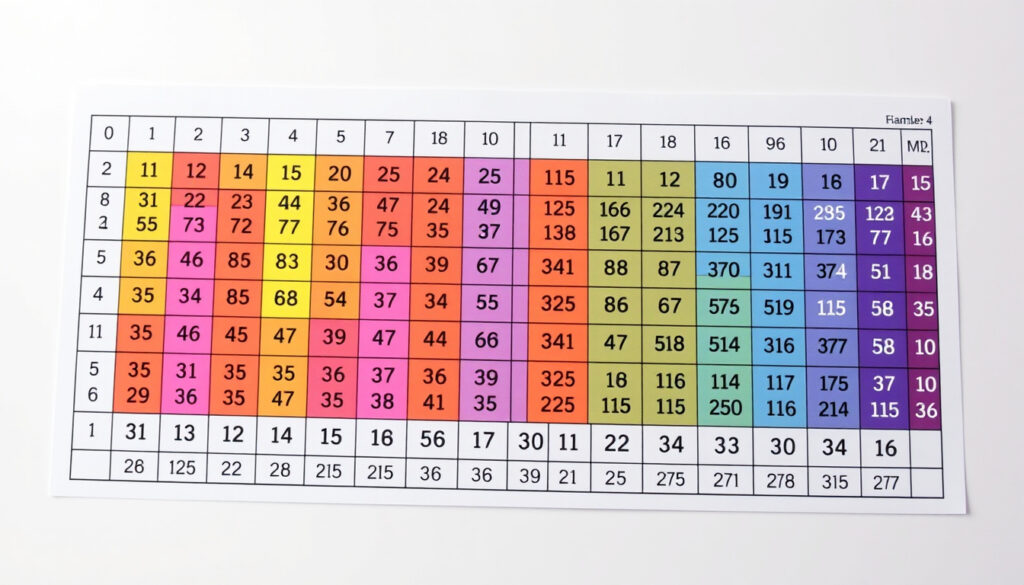
Place Value Chart: Definition, Examples & Printables
If you’ve ever watched a child freeze up when asked whether the 6 in “26” is worth the same as the 6 in “60,” you already know why educators keep returning to place value charts. These simple grids strip away the mystery of positional notation by showing each digit’s job in plain sight. What follows is a complete guide to how place value works, how to calculate it step-by-step, and where to find the best printable and interactive charts for elementary math students.
Core Positions: Ones, Tens, Hundreds, Thousands · Example: 26: 2 tens, 6 ones · Example: 364: 3 hundreds, 6 tens, 4 ones · Common Extensions: Decimals: Tenths, Hundredths · Teaching Formats: Printable, Interactive
Quick snapshot
- A place value chart is a grid that displays digit positions and their corresponding values (Math-Drills)
- The standard positions for whole numbers are ones, tens, hundreds, and thousands (Toy Theater)
- Charts extend to decimals: tenths, hundredths, and thousandths (Twinkl)
- Most free chart resources are US-centric; UK or Australia-specific curriculum alignments are rarely documented (Instructables)
- Accessibility features such as screen reader support vary widely across interactive tools (Instructables)
- Math-Drills revised its decimal chart as recently as 2024-10-11 (Math-Drills)
- Interactive digital tools are replacing printable-only resources in many K-5 classrooms (Math-Drills)
- Expect more blended printable-and-interactive resources combining hands-on manipulatives with digital feedback loops
- Decimal place value mastery will remain a gatekeeper skill through grade 6 and into pre-algebra
A place value chart does one thing clearly: it maps every digit in a number to the role that digit plays. The chart below distills the core attributes of the standard version used across K-5 math instruction.
| Label | Value |
|---|---|
| Definition | Grid showing digit positions and values |
| Key Positions | Ones, tens, hundreds, thousands |
| Example: 26 | 2×10 + 6×1 = 26 |
| Example: 364 | 3×100 + 6×10 + 4×1 = 364 |
| Decimal Extension | Tenths, hundredths, thousandths |
| Common Grades | K–5 |
What is a place value chart in math?
At its simplest, a place value chart is a structured grid that lines up every digit in a number according to its positional role. Each column represents a place — ones, tens, hundreds — and the digit sitting in that column tells you how many of that place you have. Without this system, numbers like 407 and 470 would look identical at a glance.
Overview and purpose
The chart exists because our number system is positional: the same digit “4” means something different in 40 than it does in 400. A place value chart makes that difference visible by labeling each column directly. Math-Drills offers a chart that spans from Hundred Millions on the left all the way to Millionths on the right, covering the full range students encounter from elementary through middle school (Math-Drills). Teach Starter takes a narrower approach, focusing on thousands to thousandths for grades 3–5 (Teach Starter).
Basic structure
The standard whole-number chart reads left to right: millions, hundred-thousands, ten-thousands, thousands, hundreds, tens, ones. The decimal section mirrors this on the right side of the decimal point: tenths, hundredths, thousandths. Twinkl’s chart emphasizes the decimal point itself as the separator between whole and fractional parts (Twinkl).
The implication: once students see the chart, the rule writes itself — move one place left, and the digit’s weight multiplies by ten.
How do you calculate the place value?
Calculation is straightforward once the chart is in front of you. You identify each digit, match it to its column, and multiply.
Step-by-step process
Start with a specific number, say 364. Place each digit on the chart: 3 under hundreds, 6 under tens, 4 under ones. Then multiply each digit by its place value: 3 × 100 = 300, 6 × 10 = 60, 4 × 1 = 4. Add them together: 300 + 60 + 4 = 364.
Using the chart
For decimals, the same logic extends. In 0.26, the 2 occupies the tenths place (2 × 0.1 = 0.2) and the 6 occupies the hundredths place (6 × 0.01 = 0.06). The sum is 0.26. Interactive tools from Toy Theater let students drag digits onto the chart and watch zeros auto-fill empty places, reinforcing the rule through action rather than memorization (Toy Theater). Workybooks adds ×10 and ÷10 shift buttons so learners can see what happens when a digit moves one column to the left or right (Workybooks).
What this means: every student who masters this three-step process — identify, match, multiply — can handle any whole number or decimal place value problem, no flash cards required.
How to explain place value to a kid?
Children build place value understanding fastest when the concept connects to something they already handle every day. Money is the most reliable bridge.
Simple analogies
Treat a ten-dollar bill as “one group of ten dollars” and a one-dollar coin as “one single dollar.” The number 42 becomes two groups of ten plus two ones — or, in familiar terms, two ten-dollar bills and two one-dollar coins. Twinkl’s decimal chart uses the same visual logic to extend the analogy to dimes and pennies, where 0.26 equals two dimes and six pennies (Twinkl).
Hands-on activities
Base-ten blocks give children physical pieces that correspond directly to the chart columns. A flat block represents 100, a rod 10, and a unit cube 1. By building numbers with blocks, students literally construct the relationship between digit and place. Instructables offers a DIY sheet-protector chart with slits for tenths, hundredths, and thousandths; students write digits with a dry-erase marker and hear the “and” sound when the decimal point is pressed (Instructables).
Why this matters: the tactile connection between a block and a number does something a worksheet cannot — it makes the abstract literal.
What is the place value of 6 in 26?
In the number 26, the digit 6 sits in the ones column. Its place value is simply 6 × 1, which equals 6. The 2 sits two columns to the left, in the tens place, so its place value is 2 × 10 = 20. Together, 20 + 6 = 26.
Breakdown of two-digit numbers
The rule holds regardless of the digits involved. In 42, the 4 is worth 4 × 10 = 40 and the 2 is worth 2 × 1 = 2. In 99, both digits are 9, but one is worth 90 and the other is worth 9 — a dramatic illustration of why position determines value.
Similar examples
Consider 364 from earlier. The 6 here is no longer in the ones place — it’s moved to the tens column. Its place value is now 6 × 10 = 60. The chart makes this shift obvious: the digit “6” hasn’t changed, but its job has.
The catch: students who memorize multiplication tables without this visual anchor frequently mix up which column a digit occupies. The chart prevents that confusion before it starts.
Place value chart printable
The strongest printable resources come from a handful of established educational publishers and are available at no cost.
Decimals and PDF versions
Math Salamanders hosts a collection of free printable decimal charts spanning a wide range — from ones to millions on the left, tenths to thousandths on the right (Math Salamanders). Math-Drills takes this further with a chart covering Hundred Millions to Millionths, last revised on 2024-10-11 (Math-Drills). Teachers Pay Teachers hosts free blank charts ranging from hundred thousands to thousandths or billions to thousandths, available in desk-size and binder-size formats for interactive notebooks (Teachers Pay Teachers).
Interactive options
When a static chart isn’t enough, digital tools add a feedback layer. Toy Theater’s drag-and-drop chart spans thousandths to thousands and includes ×10 and ÷10 buttons that shift all digits simultaneously, giving students a live demonstration of the multiplication-by-ten rule (Toy Theater). Workybooks covers grades K-5 with similar drag-and-drop functionality plus a clear button for repeated practice runs (Workybooks).
Teach Starter color-codes its chart from thousands to thousandths, making it easier for students to track which column they’re reading. Color distinction reduces the cognitive load of parsing a dense grid, especially for younger learners or those with attention difficulties.
Curriculum Corner includes picture-based decimal writing activities alongside its blank chart, combining visual recognition with written practice. The chart itself labels hundreds, tens, ones, decimal point, tenths, hundredths, and thousandths — leaving no label ambiguous (The Curriculum Corner).
Using place value charts in the classroom
Teachers deploy charts across three main formats: whole-class anchor charts posted on walls, individual desk charts for independent work, and digital versions for shared-screen instruction.
Whole-class and desk versions
A wall-mounted chart sets a common reference point for discussion. A desk chart — like the desk-size and binder-size versions available from Teachers Pay Teachers — lets students annotate directly during problem-solving (Teachers Pay Teachers). The two formats reinforce each other: the wall chart establishes the rule, the desk chart practices it.
Games and group activities
Super Teacher Worksheets offers a Decimal Place Value Class Game for grade 5, where students hold number cards and physically build decimal values on a chart together (Super Teacher Worksheets). This approach transforms a static chart into a social activity, giving tactile and social learners an entry point that pure worksheet practice cannot match.
Physical card games require printed materials and classroom management; digital tools require devices and reliable internet. Schools with limited tech access benefit more from print-first strategies paired with the Instructables sheet-protector DIY method, which costs under a dollar per student (Instructables).
Decimal place value: extending the chart
The decimal portion of the chart operates on the same logic as the whole-number side, but the columns represent fractions instead of whole units.
Tenths, hundredths, thousandths
The first column right of the decimal point is tenths. The second is hundredths. The third is thousandths. Each step rightward divides by ten, not multiplies. This mirrors the whole-number side exactly — the only difference is that you’re now working with pieces of a whole rather than groups of a whole.
Reading decimal numbers
To read 0.26 aloud, say “and” at the decimal point: “twenty-six hundredths.” The chart makes this explicit: 2 is in the tenths column, 6 is in the hundredths column. The same principle applies to larger decimals like 3.142, where 1 is tenths, 4 is hundredths, and 2 is thousandths.
Charts support the Common Core standard CCSS.MATH.CONTENT.5.NBT.A.3, which covers reading, writing, and comparing decimals to the thousandths place (Instructables). The standard serves as the backbone for grade 5 decimal instruction across most US curricula.
Tips for parents and tutors
Starting with whole numbers
Before touching decimals, make sure students can confidently answer “What is the place value of the digit 4 in the number 347?” The answer — 4 tens, or 40 — confirms the foundational understanding that the same digit means different things in different positions.
Building toward decimals
Once whole numbers are solid, introduce tenths using familiar objects. A chocolate bar with ten equal squares makes the concept tangible: one square is one tenth of the whole. From there, extend to hundredths with a dime (one-tenth of a dollar) and a penny (one-hundredth). The decimal chart then connects to money the child already understands.
Upsides
- Charts make positional notation visible, preventing the “4 in 40 vs. 4 in 400” confusion before it starts
- Printable versions are free from Teachers Pay Teachers, Math-Drills, and Math Salamanders
- Interactive tools like Toy Theater and Workybooks add ×10/÷10 demonstrations that static charts cannot
- Color-coded charts (Teach Starter) reduce cognitive load for younger or struggling learners
- Games like Super Teacher Worksheets turn independent practice into collaborative activity
Downsides
- Digital tools require devices and internet access — not all households have both
- Most free resources are US-aligned; UK and Australia-specific curriculum variants are scarce
- Screen reader accessibility is rarely documented in interactive tool descriptions
- Blank charts require students to fill in labels correctly, which can introduce errors if the foundational concept isn’t yet solid
For parents and tutors, the choice is straightforward: start with a free printable chart from Math Salamanders or Math-Drills for core reference, add a digital interactive like Toy Theater for demonstrations, and use a physical DIY chart (the Instructables sheet-protector method costs under a dollar) for hands-on practice without screens.
“This interactive place value chart provides a visual representation of decimals and whole numbers.” — Toy Theater educational platform
“Welcome to your interactive guide to place value! This tool is perfect for teachers and students in grades K-5.” — Workybooks educational platform
“Help your students master decimals with this versatile decimal place value chart!” — Teach Starter teaching resource provider
The pattern that emerges across all these platforms is consistent: the chart works because it externalizes a rule that would otherwise live entirely inside a child’s head. Every digit gets a column, every column gets a label, and the relationship between digit and place becomes something you can point to rather than argue about.
Related reading: Math-Drills Decimal Place Value Chart · Toy Theater Place Value Move
Frequently asked questions
What is the place value of 3 in 43?
The digit 3 sits in the tens column. Its place value is 3 × 10 = 30. The digit 4 is in the ones column and is worth 4 × 1 = 4.
What is the place value of 2 in 23?
The digit 2 is in the tens column, giving it a place value of 2 × 10 = 20. The digit 3 is in the ones column and is worth 3 × 1 = 3.
What is the place value of 6 in 364?
In 364, the digit 6 is in the tens column, so its place value is 6 × 10 = 60. The hundreds digit (3) is worth 300, and the ones digit (4) is worth 4.
What is a place value chart for decimals?
A decimal place value chart extends the whole-number chart past the decimal point to include tenths, hundredths, and thousandths columns. It helps students see that the digit “2” in the tenths column is worth 0.2, while the same digit in the hundredths column is worth only 0.02.
Where to find place value chart worksheets?
Teachers Pay Teachers offers free and paid worksheets, including blank charts for interactive notebooks. Math-Drills has a decimal chart covering Hundred Millions to Millionths, revised 2024-10-11. Super Teacher Worksheets provides a class game for grade 5 decimal practice. Curriculum Corner offers worksheets that pair picture-based decimal writing with fill-in-the-chart activities.
What is place value chart tens and ones?
A tens-and-ones chart is the simplest version, covering only two columns: tens and ones. It helps students understand that a two-digit number like 26 contains 2 tens (worth 20) and 6 ones (worth 6). This is the foundation before moving to hundreds, thousands, and decimal places.
How to use a place value chart interactive?
On tools like Toy Theater or Workybooks, drag number digits onto the chart. The chart auto-fills zeros in empty columns so students can see the placeholder rule in action. Use the ×10 and ÷10 buttons to shift all digits one column left or right, demonstrating that multiplying or dividing by ten moves every digit one place.
More related posts
 Walter Matthau: Death, Gambling, and the Lemmon Bond
 APA 7 Reference Generator: Best Free Tools & Usage Tips
 Andrew Cuomo: Verified Record and Unanswered Questions
 Time in Dublin – Current Local Time, GMT vs IST, and Travel Guide
 Difference Between: Than vs Then, Their vs There, Debit vs Credit
 Beth Behrs: Biography, Age, Career, and Social Media
 Good Movies to Watch – Top Streaming Picks 2024
 Anne, Princess Royal: Biography, Rank, Health, Family
