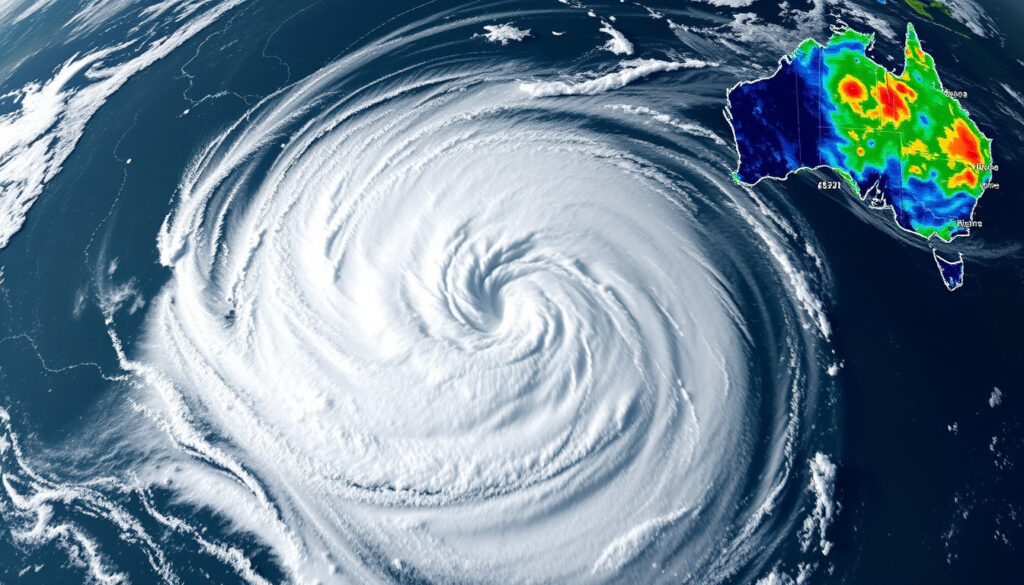
Cyclone Alfred Tracker Live – BOM Maps, Path and Impacts
Severe Tropical Cyclone Alfred (22U) traversed the Coral Sea from late February through early March 2025, ultimately making landfall between Brisbane and the Sunshine Coast on 8 March. The system peaked at Category 4 intensity with sustained winds reaching 165 km/h and gusts up to 215 km/h, leaving a trail of significant wind damage, flooding, and coastal erosion across southeastern Queensland and northeastern New South Wales.
For those seeking historical documentation of Alfred’s journey, multiple official and third-party sources have compiled detailed tracking data, satellite imagery, and meteorological analyses covering the system’s fifteen-day lifecycle from formation to dissipation.
BOM Cyclone Tracking Map for Alfred
The Bureau of Meteorology maintains a dedicated historical page for Tropical Cyclone Alfred, offering track maps, wind data, and rainfall records from the event. This official source documents Alfred’s progression from tropical low to Category 4 severe cyclone and subsequent interaction with the southeast Queensland coastline.
Satellite imagery and animated track maps on Zoom Earth provide complementary visual documentation of the system’s path from 22 February through 8 March 2025. These resources allow users to examine the storm’s erratic movement patterns, including its distinctive southeastward loop before the final westward turn toward the coast.
No live tracking capability remains active for Cyclone Alfred since the system dissipated in March 2025. Historical data including satellite images, weather maps, and recorded track information remain accessible through the Bureau of Meteorology and Zoom Earth archives.
Key Storm Statistics
Key Observations from Tracking Data
- Alfred spent approximately 22 hours at Category 4 intensity between 4am and 10pm AEST on 28 February while positioned offshore from Queensland
- Wind gusts of 120 km/h were recorded at Cape Byron on 7 March at 5:09am AEST
- The Gold Coast Seaway recorded gusts of 107 km/h on 7 March at 9:46pm AEST
- Rainfall totals exceeded 1000mm in parts of the Gold Coast Hinterland over the seven-day period ending 10 March
- Wave heights reached 6-7 metres in northern New South Wales and southern Queensland coastal waters
- The system’s final landfall occurred later than initial forecasts suggested, crossing on 8 March rather than the predicted late 6 or early 7 March
Snapshot of Cyclone Alfred
| Attribute | Details |
|---|---|
| Official Name | Severe Tropical Cyclone Alfred (22U) |
| Formation Date | 21 February 2025 (tropical low designated) |
| Named Date | 23 February 2025 at 10am AEST |
| Final Dissipation | 8 March 2025 |
| Peak Category | Category 4 |
| Peak Sustained Winds | 165 km/h (90 knots) |
| Peak Wind Gusts | 215 km/h |
| Primary Affected Regions | Southeast Queensland, Northeast New South Wales |
| Final Landfall Location | Bribie Island and mainland Moreton Bay region |
Live Cyclone Tracker Map Australia
Real-time cyclone tracking for Australian weather systems is available through the Bureau of Meteorology’s seven-day tropical cyclone forecast page. This resource provides current information on any active tropical cyclones affecting Australian waters, including the Coral Sea, Arafura Sea, and Indian Ocean regions.
For historical events like Cyclone Alfred, Zoom Earth offers archived satellite imagery and animated track visualizations covering the entire duration of the system. Users can step through the storm’s progression day by day, observing cloud patterns, wind field expansions, and the distinctive looping trajectory that made Alfred particularly challenging to forecast.
The Bureau of Meteorology’s cyclone history page for Alfred includes downloadable track maps and detailed meteorological analyses. These resources prove valuable for understanding forecast challenges and the scientific methodology behind tropical cyclone prediction.
Understanding BOM Forecast Maps
BOM tropical cyclone forecast maps typically display the predicted path cone, showing the probable track over the coming days. Key elements include the central forecast line indicating the most likely path, shaded regions representing the margin of uncertainty, and wind speed predictions at various distances from the system centre.
During Alfred’s approach toward southeast Queensland, BOM forecast maps highlighted the increasing confidence in a westward turn after the system had moved considerably further south than initial predictions indicated. The shift from an offshore southeasterly track to a direct approach toward the Brisbane-Gold Coast region marked a critical forecasting moment.
Regional Cyclone Trackers Including Darwin and WA
The Bureau of Meteorology operates separate tropical cyclone warning centres for different Australian regions, each providing targeted information for their respective areas of responsibility. The Darwin Tropical Cyclone Warning Centre monitors the Arafura Sea and western Gulf of Carpentaria, while the Perth and Brisbane offices cover the Indian Ocean and Coral Sea respectively.
Cyclone Alfred remained entirely within the Brisbane Warning Centre’s jurisdiction throughout its lifecycle. Historical records confirm the cyclone’s path concentrated on the Coral Sea corridor between Queensland and New South Wales.
Tropical Cyclone Alfred impacted southeastern Queensland and northeastern New South Wales exclusively. No tropical cyclone activity was recorded in Western Australia, the Northern Territory, or Darwin during the February-March 2025 period corresponding to Alfred’s existence.
Users seeking information about cyclone activity in other Australian regions should consult the relevant BOM state-based tropical cyclone pages. The Northern Territory experiences tropical cyclone activity primarily during the November to April wet season, while Western Australia’s cyclone season aligns with the same timeframe across its vast coastline.
Current Cyclone Warnings and Alerts
As Cyclone Alfred has dissipated, no active cyclone warnings remain in effect for this system. However, the Bureau of Meteorology continues issuing daily tropical cyclone outlooks during the Australian cyclone season, assessing potential development areas across all monitored regions.
During Alfred’s approach toward the coast from 4-8 March 2025, the Bureau issued tropical cyclone warnings spanning from Double Island Point (north of Gympie) to Yamba in New South Wales. These warnings communicated expected gales within 24 hours of the initial advisory and escalated as the system approached.
Warning Categories and Criteria
BOM tropical cyclone warnings communicate different threat levels through color-coded zones and specific messaging. Gale warnings indicate expected wind gusts of 63 km/h or greater, while more severe warnings address storm-force winds exceeding 118 km/h. The destructive and very destructive wind categories correspond to Category 3-4 and Category 4-5 intensities respectively.
Beyond wind threats, the Bureau coordinates severe weather warnings for heavy rainfall, abnormally high tides, and dangerous surf conditions accompanying tropical cyclones. During Alfred’s impact period, flash and riverine flood warnings remained active for Brisbane, the Gold Coast, and surrounding regions through 8-9 March.
For those monitoring current conditions in affected areas, QLD Road Closures provides real-time information about infrastructure impacts including flooded roads, fallen trees, and emergency closures across Queensland’s road network.
Timeline of Cyclone Alfred
Understanding the chronological progression of Cyclone Alfred helps contextualize its unusual trajectory and the forecasting challenges it presented. The following milestones mark key points in the system’s development and movement.
- 21 February 2025: Tropical low 22U forms northeast of Cooktown, Queensland, marking the beginning of the system that would become Cyclone Alfred
- 23 February 2025 (10am AEST): System is officially named Cyclone Alfred, positioned approximately 320 kilometres northeast of Willis Island
- 24 February 2025: Alfred turns south overnight, initiating the prolonged offshore journey that would take the system deep into the Coral Sea
- 28 February 2025 (4am-10pm AEST): Alfred reaches peak intensity as Category 4 severe tropical cyclone while positioned offshore from Queensland, maintaining peak winds for approximately 22 hours
- 2 March 2025: System weakens to Category 1 intensity over Cato Island, east of Rockhampton, marking the beginning of a complex intensity fluctuation period
- 3 March 2025 (4pm AEST): Alfred undergoes subtropical transition with winds between 85-100 km/h, coinciding with re-intensification to Category 2
- 4 March 2025: Dramatic westward turn initiated, with the system pivoting away from its southward trajectory toward the southeast Queensland coast
- 5 March 2025 (10pm AEST): Alfred reclassified as tropical Category 1 system, resuming tropical characteristics after the subtropical transition
- 6 March 2025 (4am AEST): System intensifies to Category 2, with forecasts projecting landfall between Brisbane and the Sunshine Coast
- 8 March 2025 (8pm AEST): Alfred crosses Bribie Island as a subtropical system; mainland crossing follows at 9pm AEST between Moreton Bay and Bribie Island
- 8 March 2025 (6:45am AEST onwards): System weakens to tropical low/ex-tropical cyclone status as it moves inland, with attention shifting to ongoing flood risks
What We Know and What Remains Uncertain
The historical record of Cyclone Alfred contains well-documented certainties alongside areas where forecasting proved particularly challenging. The following comparison clarifies established facts from aspects that remain less precisely defined.
| Established Information | Aspects with Greater Uncertainty |
|---|---|
| Peak intensity of Category 4 achieved on 28 February | Exact timing of the westward turn remained uncertain until it occurred |
| Maximum sustained winds of 165 km/h with gusts to 215 km/h | Precise landfall timing shifted several times as forecasts updated |
| System crossed between Brisbane and Sunshine Coast on 8 March | The extent of subtropical versus tropical characteristics during final approach |
| Significant flooding occurred across Gold Coast and Northern Rivers regions | Long-term recovery timeline for hardest-hit communities |
| Rainfall exceeded 1000mm in some elevated areas over the event | Climate change attribution for the specific intensity and track patterns |
| System remained east-coast focused with no NT/WA involvement | Future risk assessment for similar southeast Queensland approaches |
Understanding Cyclone Alfred’s Context
Cyclone Alfred represented one of the more notable tropical cyclone events to affect southeastern Queensland in recent years. The system’s extended lifespan of approximately fifteen days, combined with its atypical looping trajectory, distinguished it from more straightforward coastal crossing patterns.
The impact footprint extended beyond immediate wind damage to encompass prolonged heavy rainfall causing flash and riverine flooding across the Brisbane, Gold Coast, and Northern Rivers areas. Coastal erosion affected beaches throughout the region, with wave heights of 6-7 metres recorded in exposed coastal waters.
For residents of affected areas, the cyclone’s passage underscored the importance of monitoring official Bureau of Meteorology warnings and heeding evacuation advice when issued. Emergency services across Queensland and New South Wales coordinated response efforts throughout the event.
Transport networks experienced significant disruption during and after the cyclone’s passage. Sydney Train Network Emergency Delays provides information about public transport impacts during severe weather events, relevant for those travelling through New South Wales during similar future situations.
Sources and Official Information
Multiple authoritative sources document Cyclone Alfred’s characteristics, track, and impacts. The Bureau of Meteorology serves as Australia’s primary official source for tropical cyclone information, maintaining historical records and real-time forecast capabilities.
Severe Tropical Cyclone Alfred (22U) was a long-lived Coral Sea system active from 21 February to 8 March 2025, peaking at Category 4 intensity with maximum sustained winds of 165 km/h (90 knots) and gusts up to 215 km/h.
— Bureau of Meteorology, Cyclone History: Alfred 2025
Zoom Earth provides satellite imagery and animated track visualizations that complement official meteorological records. These resources allow for visual reconstruction of the system’s progression and cloud structure evolution throughout its lifecycle.
The combination of official BOM records, satellite documentation, and ground-based observation data creates a comprehensive picture of Cyclone Alfred’s characteristics and impacts. Researchers, emergency planners, and community members can access these resources for historical analysis and future preparedness purposes.
Summary
Severe Tropical Cyclone Alfred traversed the Coral Sea from 21 February to 8 March 2025, reaching Category 4 intensity before making landfall as a Category 2 system near Brisbane and the Sunshine Coast. The system’s distinctive looping trajectory and extended duration presented significant forecasting challenges, with the final westward turn occurring considerably later than initial projections suggested.
Recorded impacts included wind gusts exceeding 200 km/h at peak, rainfall totals surpassing 1000mm in elevated areas, and coastal waves of 6-7 metres affecting exposed shorelines. The Brisbane and Gold Coast regions experienced substantial flooding, while transport infrastructure across southeastern Queensland and northeastern New South Wales faced extended disruption.
Historical tracking data, satellite imagery, and official meteorological records remain accessible through the Bureau of Meteorology and Zoom Earth, providing valuable resources for understanding this significant weather event.
Frequently Asked Questions
When did Cyclone Alfred make landfall?
Cyclone Alfred crossed the coast on 8 March 2025, with Bribie Island receiving the initial landfall at approximately 8pm AEST followed by mainland crossing near Moreton Bay around 9pm AEST.
What was Cyclone Alfred’s peak intensity?
Alfred reached Category 4 severe tropical cyclone status on 28 February 2025, with sustained winds of 165 km/h and gusts up to 215 km/h while positioned offshore from Queensland.
Where can I access Cyclone Alfred tracking maps?
Historical tracking maps are available through the Bureau of Meteorology’s cyclone history page for Alfred and through Zoom Earth’s archived storm data covering the period from 22 February to 8 March 2025.
Did Cyclone Alfred affect Western Australia or the Northern Territory?
No. Cyclone Alfred remained entirely focused on the Coral Sea corridor affecting southeastern Queensland and northeastern New South Wales. There is no record of the system impacting Western Australia, the Northern Territory, or Darwin.
What regions experienced the worst impacts from Cyclone Alfred?
The hardest-hit areas included the Gold Coast and its hinterland, the Northern Rivers region of New South Wales, Brisbane, and coastal communities between the Sunshine Coast and Cape Byron.
Is there a live cyclone tracker still available for Alfred?
No. Cyclone Alfred dissipated in March 2025, and no live tracking capability remains active for this system. Historical data including satellite imagery, track maps, and meteorological records are accessible through official archives.
What was the total rainfall recorded during Cyclone Alfred?
The highest seven-day rainfall total reached 1146mm at Upper Springbrook in Queensland, with Lower Springbrook recording 1048mm. Multiple locations across the Gold Coast and Northern Rivers regions exceeded 800mm during the event.
More related posts
 Avenue Hotel Canberra – Location, Amenities & Reviews
 Tax Calculator 2025: Best Ireland Income Tools Compared
 James Spader: Medical Condition, Wife, Net Worth, Career
 Unfair Dismissal WA: Grounds, Payouts & Is It Worth Fighting?
 Green Cross Vet: Pricing, Locations, Reviews & Services
 What Happened to Salt Bae? The Decline of the Viral Chef
 Timer 5 Minutes: Free Online Countdown Timer Tools
 Olivia Newton-John: Cause of Death, Funeral, and Legacy
