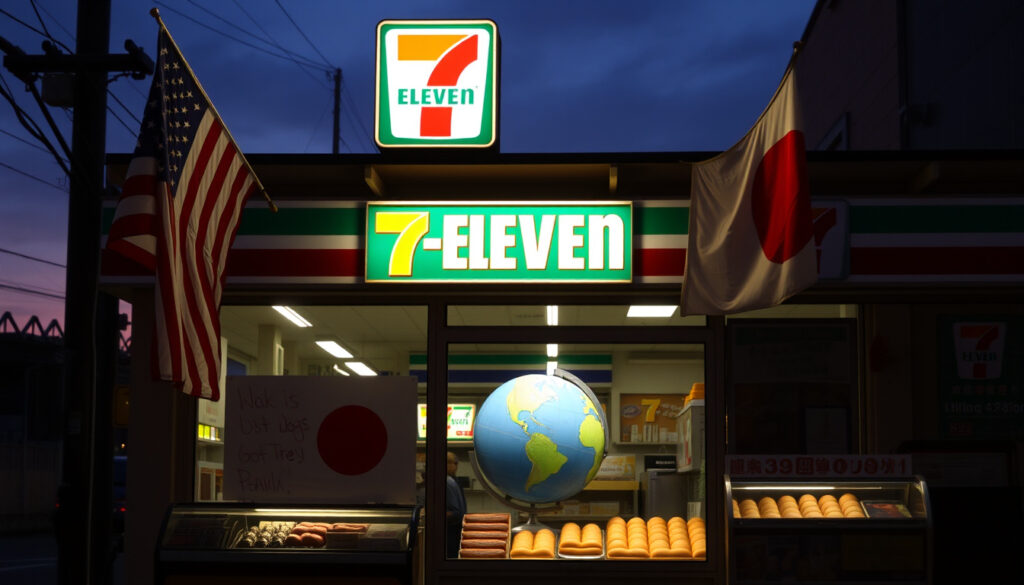
7-Eleven: American or Japanese? Global Reach & Controversies
Few convenience store brands spark the identity question quite like 7-Eleven. It was born in the United States, but today its parent company is Japanese — a shift that happened quietly over two decades. This article untangles its dual nationality, where you can actually find its stores, and the controversies that keep it in the news.
Founding year: 1927 ·
Headquarters: Irving, Texas, USA ·
Parent company: Seven-Eleven Japan Co., Ltd. ·
Global stores: over 84,000 ·
Countries present: 19 ·
Largest market: Japan (over 21,000 stores)
Quick snapshot
- Specific future expansion plans into the UK or mainland Europe are not publicly confirmed
- The exact impact of Japan’s “1/3 rule” on total food waste is not precisely quantified
- Details of the FTC settlement enforcement beyond the fine are not fully public
- 1927: Founded as an ice house in Dallas, Texas
- 2005: Seven-Eleven Japan acquires full ownership
- 2023: Record A$98 million class-action settlement in Australia
- Seven & i Holdings is shifting U.S. stores toward fresh foods (Wikipedia)
- Australian franchise was purchased by Seven & i in 2024 (Wikipedia)
- Franchisee power dynamics remain under scrutiny (Wikipedia)
Six key facts, one pattern: 7-Eleven is a global brand with a layered identity that confuses even regular customers.
| Label | Value |
|---|---|
| Founding date | 1927 |
| Current parent | Seven & i Holdings Co., Ltd. (Japan) |
| CEO | Joseph DePinto (since 2005) |
| Number of employees | approx. 25,000 (global) |
| Annual revenue | $62 billion (2022, estimated) |
| Store count | 84,500+ (as of 2024) |
Is 7-Eleven American or Japanese?
American origins and headquarters
7-Eleven began in the United States as an ice-cream-related convenience store concept before becoming a 24-hour chain (Wikipedia). Its headquarters remain in Irving, Texas, and it is legally registered as 7-Eleven, Inc., a U.S. corporation. For decades, Southland Corporation owned and operated the brand across America.
Japanese ownership since 2005
In 1991, Ito-Yokado, a Japanese retail group, acquired a 70% stake in Southland Corporation (AB Explained on YouTube). By November 2005, the Japanese side increased ownership to 100%, making 7-Eleven, Inc. a wholly owned subsidiary of Seven-Eleven Japan Co., Ltd. The parent holding company, Seven & i Holdings, was formed that same year. So the brand is American-born but entirely Japanese-owned.
The implication: Anyone walking into a 7-Eleven in the U.S. is stepping into a store operated by a Japanese parent, even if the Slurpee machine looks the same as it did 40 years ago.
Are there any 7-Eleven stores in Europe?
Limited European presence
7-Eleven’s global footprint is uneven, with the strongest presence in Asia and North America rather than Europe. The brand operates in Denmark, Norway, and Sweden under license, but there are no official 7-Eleven stores in the UK or mainland Europe outside Scandinavia.
Why Europe is tough
Existing strong convenience store cultures — Tesco Express in the UK, Spar in many countries, and local kiosk traditions — make entry difficult. The brand focuses expansion in markets with higher growth potential, such as Asia and the Americas.
The trade-off: 7-Eleven’s European footprint remains small, but in Scandinavia it holds a recognizable niche.
What is the 7-Eleven controversy?
Australian class-action settlement
In April 2022, 7-Eleven Australia settled a class-action lawsuit with franchisees for A$98 million. The lawsuit alleged that franchisees had been misled about the profitability of the business model (FTC press release).
Power imbalance concerns
Labor and franchise controversies often center on power imbalances between franchisor and franchisees. The U.S. business historically relied more heavily on gasoline and cigarettes than the Japanese model, which can squeeze franchisee margins.
What this means: For franchisees, the brand’s global scale doesn’t guarantee local profitability — it often creates friction over fees and operational control.
What is the 1/3 rule in Japan?
Definition and origin
The 1/3 rule is a Japanese industry practice that divides product shelf life into three parts: one-third for production and distribution, two-thirds for sale. It is not a formal legal requirement but a widely followed custom that contributes to significant food loss in the convenience store sector.
The catch: While the rule is intended to ensure freshness, it forces stores to discard food that is still safe to eat, creating an environmental and economic challenge.
Why is there no 7-Eleven in the UK?
Market dynamics
7-Eleven has not entered the UK due to intense competition from established chains like Tesco Express and Spar. Previous franchise attempts did not succeed, and the brand focuses expansion in markets with higher growth potential.
Why this matters: UK shoppers may recognize the brand from travel, but they won’t find a local 7-Eleven — and the company shows no signs of changing that.
Upsides
- Global brand recognition and consistent product offerings
- Japanese operational excellence drives innovation (e.g., fresh food push)
- Strong franchise support in mature markets (Japan, Thailand)
Downsides
- Franchisee lawsuits highlight profit margin issues
- Uneven expansion leaves Europe and UK underserved
- Dependence on gasoline sales in U.S. creates vulnerability
Franchisees entering the 7-Eleven system face a model where Japanese operational rigor meets American market realities — the gap between parent expectations and local profits has fueled repeated legal battles across multiple countries.
Despite being Japanese-owned since 2005, 7-Eleven’s U.S. stores still generate the majority of their revenue from gasoline and cigarettes, a pattern the parent company is now actively trying to shift toward fresh foods.
Timeline of key events
- : 7-Eleven founded as an ice house in Dallas, Texas.
- : Brand renamed to 7-Eleven to reflect extended hours.
- : First Japanese store opens under license to Seven-Eleven Japan.
- : Seven-Eleven Japan acquires full ownership of 7-Eleven, Inc.
- : 7-Eleven pays A$98 million settlement in Australia.
Confirmed facts vs what’s unclear
Confirmed facts
- 7-Eleven, Inc. is legally American (headquarters in Irving, Texas).
- Seven-Eleven Japan is the sole owner since 2005.
- The brand operates in 19 countries including Japan, Thailand, and Mexico.
- The 1/3 rule contributes to food loss in Japan.
What’s unclear
- Specific future expansion plans into UK or mainland Europe are not publicly confirmed.
- The exact impact of the 1/3 rule on total food waste is not precisely quantified.
- Details of the FTC settlement enforcement beyond the fine are not fully public.
Quotes
The class-action settlement underscores the tension between the franchisor’s global strategy and franchisees’ local realities.
— Analysis of 7-Eleven Australia lawsuit, 2022
In Japan, 7-Eleven stores are bound into a wider networked franchise system with centralized coordination.
— AB Explained
For the convenience store industry, the 7-Eleven story is a lesson in brand duality. American in origin, Japanese in ownership, and global in ambition — the brand now faces a critical choice in Europe and the UK: expand or concede the territory to local players. For franchisees, the choice is equally stark: accept the parent company’s evolving model or risk further legal battles. The next decade will reveal whether 7-Eleven can reconcile its heritage with its future.
For a practical guide to finding stores worldwide, see 7-Elevens global reach.
Frequently asked questions
Who founded 7-Eleven?
7-Eleven was founded in 1927 by Joe C. Thompson in Dallas, Texas.
Where is 7-Eleven headquartered?
Irving, Texas, USA.
How many 7-Eleven stores are in Japan?
Over 21,000, making it the largest market.
Does 7-Eleven have a store in London?
No, there are no official 7-Eleven stores in the UK.
What is the 1/3 rule in Japanese convenience stores?
An industry custom dividing product shelf life into thirds — one for production/distribution, two for sale.
What is the FTC fine about for 7-Eleven?
The FTC fined 7-Eleven $4.5 million in 2023 for antitrust violations related to franchisee competition.
Does 7-Eleven sell gasoline?
Yes, many U.S. locations include gas stations.
Is 7-Eleven a franchise?
Yes, the vast majority of stores operate under a franchise model.
More related posts
 Vicky Kaushal Biography: Age, Height, Net Worth, Films, and Personal Life
 Cast of Top Boy: Summerhouse – Full List and Characters
 Kevin James: Biography, Controversies, and Net Worth Explained
 A Discovery of Witches – Books, TV Cast and Streaming Guide
 Egyptian Gods: Complete Pantheon Guide
 Elliott Smith: Death, ‘Miss Misery’, and Cobain/Buckley Links
 Leonardo DiCaprio: Health, Relationships, and Teeth Facts
 Black Forest Cake Recipe – Authentic Schwarzwälder Kirschtorte
