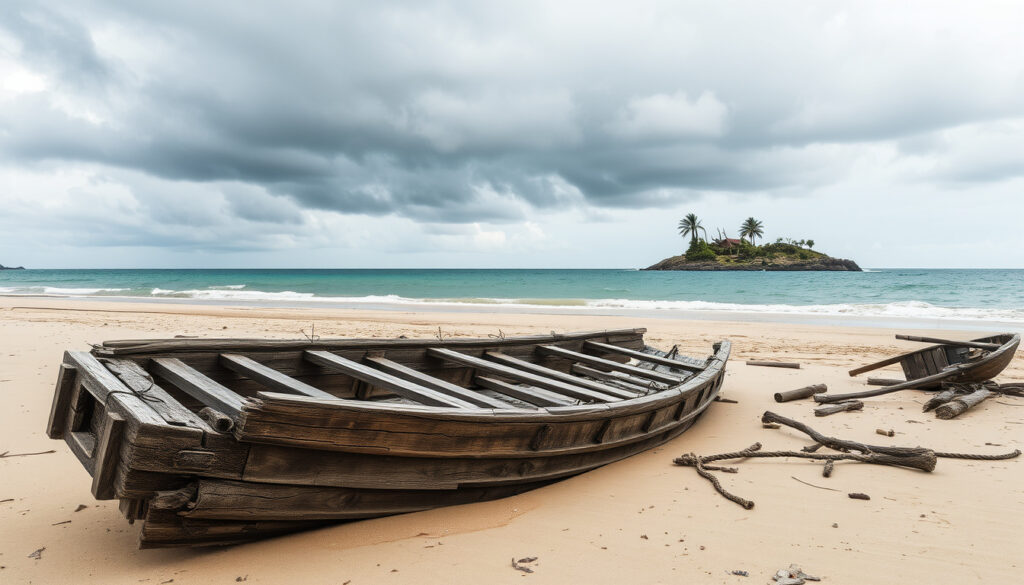
Robinson Crusoe: Summary, True Story, Moral, and Ending Explained
Few fictional castaways have lodged in the collective imagination quite like Robinson Crusoe. Daniel Defoe’s novel, first published on 25 April 1719, tells the story of a shipwrecked mariner who survives 28 years on a tropical island. But how much of Crusoe’s adventure came from Defoe’s imagination, and how much from the real-life castaway Alexander Selkirk? Here’s a fact-checked breakdown of the plot, the true story behind it, the moral lessons, the reading difficulty, and what happens at the end.
First published: 25 April 1719 ·
Author: Daniel Defoe ·
Years Crusoe spent on island: 28 ·
Original title: The Life and Strange Surprizing Adventures of Robinson Crusoe
Quick snapshot
- Robinson Crusoe is a fictional novel by Daniel Defoe, published in 1719 (Miami University Libraries (Primary Source Collection))
- The full original title is The Life and Strange Surprizing Adventures of Robinson Crusoe, of York, Mariner (Miami University Libraries)
- The story was inspired by the real castaway Alexander Selkirk (Britannica (Encyclopedia Entry))
- Whether Defoe ever met Selkirk directly is unknown (BBC News (Investigative Feature))
- The exact nature of Crusoe’s illness is left ambiguous in the text (analysis from Wikipedia (Literary Analysis))
- 1659: Crusoe is shipwrecked on the island (Britannica)
- 1687: He rescues Friday (Audible (Summary Context))
- Crusoe returns to England as a wealthy man and marries (Britannica)
- The novel continues to be studied in classrooms worldwide (Study.com (Educational Resource))
The key facts of Defoe’s masterpiece show a work that blends fiction with a seed of real events. Six details anchor the novel’s identity.
| Fact | Detail |
|---|---|
| Full title | The Life and Strange Surprizing Adventures of Robinson Crusoe |
| Author | Daniel Defoe |
| Publication date | 25 April 1719 |
| Protagonist | Robinson Crusoe |
| Setting | A tropical island off the coast of South America (fictional) |
| Time span | 28 years, 2 months, 19 days |
What is the story Robinson Crusoe about?
Plot overview
-
Robinson Crusoe defies his parents’ wishes and goes to sea. After a series of adventures, he is shipwrecked on a remote island where he must survive alone (Study.com (Educational Synopsis)).
-
Over 28 years, he builds a shelter, learns to farm, domesticates goats, and eventually rescues a native man he names Friday (Britannica (Plot Summary)).
-
The novel closes with Crusoe’s rescue and return to England, where he lives out his days in comfort (Audible (Summary Context)).
Main characters
- Robinson Crusoe – the narrator and protagonist, a restless Englishman who seeks adventure.
- Friday – a Caribbean native whom Crusoe rescues from cannibals; he becomes Crusoe’s loyal companion.
The implication: Defoe’s stripped-down survival plot still feels modern because it focuses on one person’s ingenuity facing total isolation.
Was Robinson Crusoe a true story?
The real Alexander Selkirk
Robinson Crusoe is a fictional character, but the novel was inspired by the real-life castaway Alexander Selkirk. Selkirk, a Scottish sailor, survived alone on the island of Más a Tierra (now part of the Juan Fernández Islands) for four years after being marooned in 1704 (BBC News (Historical Feature)). He was rescued in 1709. Defoe’s novel, published a decade later, elaborated Selkirk’s experience into a 28-year saga depicted by Britannica (Encyclopedia Entry) as “the most famous survival story in English literature.”
Differences between Selkirk and Crusoe
- Selkirk spent 4 years alone; Crusoe spent 28.
- Selkirk never had a Friday companion; Friday is a purely fictional addition.
- Defoe never claimed his novel was factual; it was marketed as a fictional adventure.
The pattern: Defoe borrowed the kernel of a marooned sailor, but inflated the duration, added moral drama, and invented a native sidekick to serve the narrative.
What is the moral story of Robinson Crusoe?
Themes of repentance and providence
Crusoe’s spiritual journey from disobedience to repentance is the novel’s core arc. He begins as a rebellious son who ignores his father’s advice and attributes his eventual survival to divine providence (Scribd (Moral Values Analysis)). Manual labor and self-reliance become the practical expression of his newfound faith.
Self-reliance and colonialism
The novel also serves as an allegory of colonial conquest: Crusoe masters his environment, imposes his will on Friday, and treats the island as his personal dominion. Modern critical readings, like those compiled on Wikipedia (Literary Analysis), view this as a reflection of early-18th-century imperialism.
The catch: What was once seen as a straightforward morality tale is now read as a complex artifact of colonial ideology.
Is Robinson Crusoe a hard read?
Reading level and language
The original 1719 text uses 18th-century English with long, winding sentences. According to readability analyses, the novel sits at approximately an 8th–9th grade Flesch-Kincaid level (Goodreads (Reader Community)). Modern readers may find the archaic vocabulary and moralizing digressions challenging.
Modern editions and adaptations
Abridged and annotated versions are widely available for younger readers. Educational platforms such as Study.com (Classroom Resource) offer simplified summaries that make the story accessible to students.
Why this matters: For a student or casual reader, jumping straight into Defoe’s original can be tough, but a good abridgment preserves the adventure while cutting the dense commentary.
Does Robinson Crusoe have a happy ending?
Resolution of the island experience
After 28 years, Crusoe helps a mutinied ship reclaim control and is taken aboard as a passenger. He returns to England a wealthy man, having accumulated gold and goods from the wreck (Britannica (Plot Conclusion)).
Crusoe’s return to England
Back in society, Crusoe marries, has three children, and dies content. Friday accompanies him on one final journey. The ending is conventionally happy for the hero, though modern readers may note the cost: Friday’s role remains subservient, and the island is left behind without regard for its original inhabitants.
The trade-off: Crusoe gets a triumphant homecoming, but the novel’s colonial assumptions complicate any simple “happily ever after.”
Timeline
- 1659 – Crusoe is shipwrecked and arrives on the island (Britannica).
- 1660–1686 – He builds shelter, farms, and explores the island (Britannica).
- 1687 – Crusoe rescues Friday from cannibals (Audible (Timeline Context)).
- 1688 – Crusoe and Friday help a mutinied ship; Crusoe returns to England (Britannica).
Clarity: What’s confirmed and what’s still uncertain
Confirmed facts
- Robinson Crusoe is a fictional novel by Daniel Defoe.
- The novel was published in 1719.
- Crusoe was inspired by the real castaway Alexander Selkirk.
- Defoe was imprisoned in 1703 for a satirical pamphlet (Miami University Libraries (Historical Context)).
What’s unclear
- Whether Defoe ever met Selkirk directly is unknown (BBC News).
- The exact nature of Crusoe’s illness is left ambiguous in the text (Wikipedia (Textual Analysis)).
Quotes from the experts
“I was born in the year 1632, in the city of York, of a good family, though not of that country, my father being a foreigner of Bremen, who settled first at Hull.”
– Daniel Defoe, opening of Robinson Crusoe (Miami University Libraries (Original Text Facsimile))
“Defoe’s novel is a clear allegory of colonial conquest, in which Crusoe’s mastery over the island and Friday mirrors the European colonial project.”
– Critic James Joyner (analysis shared via Wikipedia (Literary Criticism))
“Robinson Crusoe is often regarded as one of the first realistic works of fiction in English literature.”
– Wikipedia (Literary Classification)
Bottom line: Defoe spun a real marooning into a legendary survival epic. For students: abridged editions are your friend. For casual readers: the original is dense but rewarding if you stick with it.
For a closer look at the true story behind Crusoe, readers can explore how Defoe’s work parallels real survival tales.
Frequently asked questions
Who wrote Robinson Crusoe?
Daniel Defoe (1660–1731), an English writer, journalist, and pamphleteer, wrote the novel (Britannica).
Why did Robinson Crusoe leave home?
Crusoe left home against his parents’ wishes to seek adventure at sea, a decision he later comes to regret as a sin of disobedience (Study.com (Lesson Summary)).
What did Robinson Crusoe eat on the island?
He ate goats, turtles, grapes, and later barley and rice that he learned to cultivate (Britannica (Survival Details)).
Who is Friday in Robinson Crusoe?
Friday is a Caribbean native Crusoe rescues from cannibals; he becomes Crusoe’s servant and companion (Audible (Character Description)).
What is the main theme of Robinson Crusoe?
The main theme is survival through self-reliance and repentance, with colonial undertones (Scribd (Moral Values Document)).
How many sequels did Defoe write to Robinson Crusoe?
Defoe wrote two sequels: The Farther Adventures of Robinson Crusoe (1719) and Serious Reflections During the Life and Surprising Adventures of Robinson Crusoe (1720) (Wikipedia (Sequel Information)).
Is Robinson Crusoe based on a real person?
Yes, partially. The novel was inspired by the real castaway Alexander Selkirk, who survived alone on an island for four years (BBC News).
For anyone curious about the line between historical fact and literary invention, the takeaway is clear: Defoe transformed a real four-year ordeal into a 28-year allegory of resourcefulness and colonial mastery. The consequence for modern readers is that you can enjoy the adventure while asking sharp questions about whose story is being told – and whose is being silenced.
More related posts
 Waterproof Jacket Guide: Best Picks for Ireland 2025
 Airlines Cathay Pacific 2025 Review: Worth It vs Emirates
 Beef TV Show: What It’ About, Ca t, and Worth Watching?
 Tilly Ramsay: Age, Net Worth, Relationship, and Family Facts
 Allianz CTP Renewal Online – Step-by-Step NSW QLD Guide
 Nike Air Max 97 Review: Comfort, Style & Worth in 2025
 Cheyanne King: Age, Job, Ethnicity & Marriage to Gavin Casalegno
 Qatar Airways vs Emirates: Which Is Better for You in 2025
